Concrete Engineering Solutions

Why Structural Engineering Investigations Prevent Costly Concrete Failures?

Category: Concrete Resurfacing
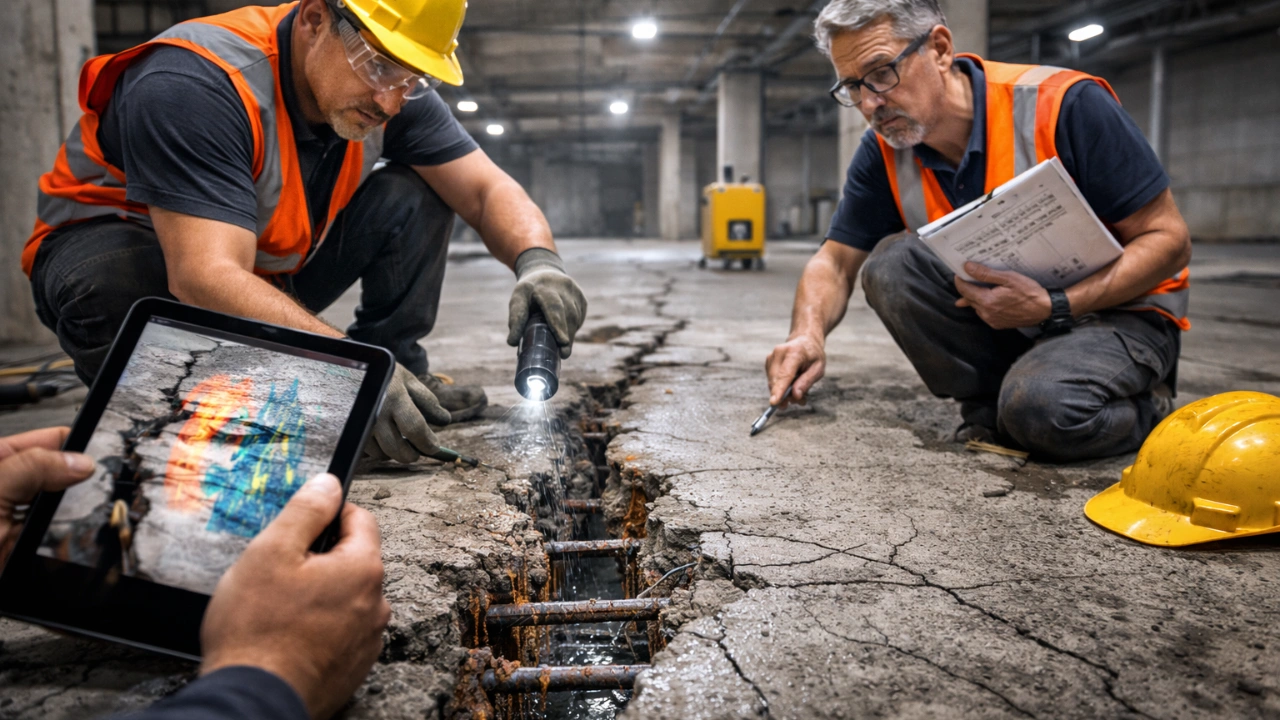
Why Structural Engineering Investigations Prevent Costly Concrete Failures

Concrete failures rarely happen without warning. Cracking, movement, water ingress or unexpected deterioration are usually symptoms of underlying issues rather than isolated defects. The problem is not that these signs appear; it’s that they are often misunderstood or addressed too late.

A structural engineering investigation is intended to answer the most important questions before remediation begins: why the issue occurred, whether it is ongoing, and what technical outcome is required to restore performance. Without this step, repairs risk being misdirected, temporary or unnecessarily expensive.


The Purpose of a Structural Engineering Investigation

The purpose of a structural engineering investigation is not to catalogue defects. It is to identify causes, assess implications and guide decisions that affect safety, durability and cost.

An investigation typically aims to:

  • Determine whether observed damage is structural or superficial
  • Understand load paths and how they have changed over time
  • Assess whether deterioration is progressive or stabilised
  • Identify contributing factors such as moisture, movement or construction detail
  • Define repair objectives aligned with long-term performance

In practical terms, it provides the evidence base for selecting the right remediation strategy, rather than the quickest or most convenient one.


When Investigations are Required: Signs and Triggers

Not every surface defect requires a full investigation. However, certain signs and triggers should prompt an engineering assessment before any repair is specified.

Common Triggers

  • Cracks that are wide, stepped, or increasing over time
  • Recurrent cracking after previous repairs
  • Differential movement between adjoining elements
  • Water ingress associated with cracking or joints
  • Corrosion staining or concrete spalling
  • Changes in building use that increase loading

In Sydney, investigations are particularly important for older assets where original documentation may be limited, and for post-tensioned structures where drilling or repairs can carry a higher risk.


Why Skipping Investigation is a High-Risk Decision

When remediation proceeds without understanding the cause, the outcome is often predictable: the problem returns.

Skipping the investigation can lead to:

  • Repairs that address symptoms but not causes
  • Locking in stresses that create new cracking
  • Incompatible repair materials or methods
  • Escalating costs as multiple repair cycles are required

For example, sealing a crack caused by ongoing movement may temporarily improve appearance, but it does nothing to restore structural continuity. The result is often further cracking adjacent to the repair.

From a risk perspective, the most expensive failures are rarely sudden; they are the cumulative result of incorrect early decisions.


How Investigations Guide Correct Repair Methods

A key value of investigation is that it narrows the solution set. Rather than asking “what repair can we apply?”, the question becomes “what outcome is required to restore performance?”

Matching Repairs to Causes

  • If cracking has compromised continuity, concrete crack injection may be required to re-establish load transfer.
  • If deterioration is limited to the surface zone, resurfacing may be appropriate once underlying issues are addressed.
  • If movement is ongoing, repairs may need to accommodate or control that movement rather than restrain it.

This cause-and-effect approach prevents over-repair in some cases and under-repair in others.


Avoiding Over-Repair and Unnecessary Replacement

One of the most overlooked benefits of investigation is cost control through precision. Without evidence, decisions tend to be conservative, often defaulting to removal and replacement.

However, full replacement is disruptive, costly and not always technically justified. In many Sydney assets, the structure remains sound while surface performance has declined. In such cases, targeted repair strategies can be adopted confidently.

This is where solutions like concrete resurfacing in Sydney can be specified appropriately, after confirming that the underlying element is structurally adequate and that resurfacing will deliver durable results.


The Role of Context in Sydney’s Built Environment

Sydney’s construction context adds complexity to remediation decisions:

  • Coastal exposure accelerates moisture-related deterioration
  • High-rise and podium structures rely on post-tensioned systems
  • Mixed-age building stock includes legacy detailing
  • Many sites remain operational during remediation

Investigations account for these realities. They ensure repairs are compatible with the asset’s environment, usage, and constraints, not just the visible defect.


FAQs

When should an engineering investigation be carried out?
When defects suggest structural involvement, are recurring, or may affect safety or durability.

Can repairs proceed based on visual assessment alone?
Visual assessment identifies symptoms, not causes. Investigation provides the basis for effective repair.

Does investigation slow projects down?
In most cases, it prevents delays by avoiding failed repairs and rework.

Is the investigation only for major defects?
No. Early investigation often reduces the scope and cost of remediation.


Investigations as a Risk-Management Tool

Beyond technical outcomes, investigations play a critical role in risk management. They provide:

  • Defensible decision-making
  • Alignment with duty-of-care obligations
  • Clear justification for repair scope
  • Reduced likelihood of dispute or escalation

For asset owners and project managers, this clarity is as valuable as the technical findings themselves.


Making Informed Remediation Decisions

Effective remediation is not about applying the strongest repair; it is about applying the right one. Structural engineering investigations ensure that repair methods align with:

  • The nature of the defect
  • The behaviour of the structure
  • The intended future use of the asset

This alignment is what prevents short-term fixes from becoming long-term liabilities.


Summary

Concrete failures are rarely sudden or isolated. They develop over time, often signalling their presence well before serious consequences arise. The difference between a controlled repair and a costly failure often comes down to one decision: whether the problem was properly understood before action was taken.

Structural engineering investigations provide that understanding. They turn uncertainty into evidence and guide repairs that restore performance, manage risk and protect value.

In Sydney’s complex built environment, that clarity is not optional; it is essential.

What Can Go Wrong If You Skip Concrete Scanning Before Drilling?

Category: Concrete Resurfacing

Concrete Scanning in Sydney

Concrete drilling is a routine activity across construction, remediation and asset maintenance projects in Sydney. Because it is common, it is often underestimated. Skipping concrete scanning before drilling remains one of the most frequent and preventable causes of safety incidents, structural damage and costly project delays across commercial and civil works.

In modern Australian construction, drilling into concrete without knowing what lies beneath is no longer a calculated risk; it is a failure in planning.

Why Concrete is Rarely “Empty”

Concrete slabs, walls and structural elements almost always contain embedded components that are not visible from the surface. These may include:

  • Post-tension or pre-tension cables
  • Reinforcing steel (reo)
  • Electrical conduits and live services
  • Water, gas or fire services
  • Structural beams, thickenings or load zones

On older sites across Sydney, documentation is often incomplete, inaccurate or missing altogether. Even on new builds, last-minute service changes can differ from drawings. This is why relying solely on plans is not sufficient.


The Most Common Failures When Scanning Is Skipped

  1. Post-Tension Cable Strikes

Post-tension cables are stressed under significant force. Striking a live tendon can cause:

  • Sudden cable release
  • Violent concrete spalling
  • Serious injury to workers
  • Permanent structural damage

In Sydney, post-tension systems are widely used in car parks, commercial floors and residential towers. A single strike can halt a project instantly and require extensive engineering assessment and remediation.

  1. Damage to Live Electrical Services

Electrical conduits are often embedded within slabs and walls. Drilling without prior scanning can result in:

  • Electrocution risk
  • Fire hazards
  • Shutdown of essential building services
  • Emergency repairs and compliance breaches

From commercial offices to hospitals and data centres, service continuity is critical. Damage to live electrical infrastructure can have consequences well beyond the work zone.

  1. Water, Gas and Fire Service Breaches

Water, gas and fire services are commonly installed within concrete elements. Accidental damage can lead to:

  • Flooding and water damage
  • Gas leaks and evacuation
  • Fire system impairment
  • Insurance and liability exposure

These incidents are particularly disruptive on operational sites, where downtime translates directly into financial loss.

  1. Compromising Structural Reinforcement

Reinforcing steel is essential to the load-bearing performance of concrete. Drilling through reo without understanding spacing, depth and load paths can:

  • Reduce structural capacity
  • Create stress concentrations
  • Lead to cracking or long-term deterioration
  • Trigger the need for structural rectification

This is especially critical when installing anchors, fixings or penetrations in load-sensitive zones.

  1. Injury, Equipment Damage and Site Shutdowns

Beyond structural consequences, unplanned strikes frequently result in:

  • Damaged drill bits and coring equipment
  • Lost productivity
  • Site shutdowns for investigation
  • SafeWork and compliance scrutiny

In Sydney’s regulated construction environment, even a minor incident can escalate quickly.

The Financial and Programme Impact

Skipping scanning may appear to save time at the outset, but the downstream costs are significant:

  • Emergency repairs
  • Specialist remediation works
  • Engineering investigations
  • Delays to critical path activities
  • Contractual disputes and variations

In many cases, the cost of rectifying a single strike far exceeds the cost of professional scanning undertaken beforehand.

Compliance and Liability in the Australian Context

Australian Standards, WHS obligations and duty-of-care requirements place responsibility on contractors and project managers to identify and manage foreseeable risks.

Drilling blind into concrete where scanning is readily available may be considered a failure to implement reasonable risk controls. This can expose parties to:

  • Regulatory action
  • Insurance complications
  • Legal liability
  • Reputational damage

Across Sydney, scanning is increasingly viewed not as an optional precaution, but as a baseline compliance measure.

Why Professional Concrete Scanning Changes the Outcome

Engaging professional Concrete Scanning in Sydney before drilling provides clarity and certainty. Using non-destructive methods, scanning identifies embedded elements, enabling work to be planned safely and accurately.

Professional scanning allows teams to:

  • Confirm safe drilling zones
  • Adjust penetration locations before work begins
  • Protect structural integrity
  • Reduce safety risks
  • Maintain programme certainty

This is particularly important on complex or high-risk sites, including multi-storey buildings, infrastructure assets and occupied facilities.

The Role of GPR in Modern Construction

GPR Scanning services in Sydney use Ground Penetrating Radar to detect objects within concrete by transmitting high-frequency radio waves and interpreting reflected signals.

When applied correctly, GPR can identify:

  • Post-tension and pre-tension cables
  • Reinforcement layout
  • Conduits and services
  • Slab thickness and cover
  • Structural anomalies such as voids

The value of GPR lies not only in detection, but in accurate interpretation. Experienced technicians and engineers understand how to distinguish critical elements from background noise and construction artefacts.

Why “Guesswork” Is No Longer Acceptable

Historically, trades relied on experience, assumptions or limited drawings. In today’s environment, this approach is increasingly risky.

Sydney construction sites are:

  • More complex
  • More densely serviced
  • More regulated
  • Less tolerant of avoidable incidents

Scanning replaces uncertainty with verified information, allowing decisions to be made confidently and defensibly.

Answering Common Questions

Is concrete scanning really necessary before drilling?
Yes. Concrete almost always contains hidden services or reinforcement. Scanning identifies these risks before damage occurs.

Can drawings replace concrete scanning?
No. Drawings may be outdated or incomplete. Scanning confirms actual site conditions.

What happens if a post-tension cable is hit?
It can cause structural damage, safety incidents and require immediate engineering intervention.

Is scanning only needed on large projects?
No. Even small penetrations can cause major issues if services or reinforcement are struck.

The Bottom Line

Skipping concrete scanning before drilling is one of the most common and costly mistakes on Sydney construction sites. The risks extend beyond immediate damage to include safety incidents, structural compromise, compliance exposure and project delays.

Professional scanning is a practical, proven way to manage these risks. It supports safer work practices, better decision-making and long-term asset performance.

In a construction environment where accuracy, safety and accountability matter more than ever, drilling blind is no longer an acceptable option.

Increase Your Property’s Resale Value with Expert Concrete Resurfacing in Sydney

Category: Concrete Resurfacing

Concrete resurfacing in Sydney

Are you opting for property selling? Thinking of ways to increase the property value?

Every homeowner looks for ways to increase the property’s selling value. Even property investors focus on property renovation to get the best seller and price.

In Sydney, one of the best and proven ways to get the best value is concrete resurfacing. Concrete resurfacing in Sydney helps restore the structural integrity and address any structural deformities. From internal flooring to an externally appealing driveway, concrete resurfacing is the ultimate solution for upgrading your home. Additionally, it is not only suitable for residential buildings but also for commercial buildings.

Explore ways to enhance the home’s value with this process and get the best value for your property. 

Ways to beautify the home with concrete

  1.  Enhance the outdoor space.

In Sydney, most houses have an outdoor living area, which is the most preferred location for families. Enhancing the place with concrete resurfacing is the best idea. Decorative driveways, well-designed pathways, pool railings or alfresco are the best ways to beautify the space.

  1.  Permanent fence with concrete

To boost your home’s resale value, permanent fencing is a good idea. Some people prefer posts made of concrete, while others make a fence entirely of concrete. Whichever option you choose, it makes the wall sturdy and hard to break.

  1.  Add concrete steps to the front door.

Sydney is an area of high precipitation. Adding concrete stairs would improve drainage and enhance the front yard’s appearance. You can also imitate the cobbled pathway look even with the stairs.

  1.  Polished concrete flooring

Polished concrete floors are popular for their low maintenance and durability. Such flooring is highly resistant to any wear and tear. They impart the modern flooring look and enhance the overall look of the house. If you prefer contemporary designs for your home, it is a perfect choice.

  1.  A designed driveway

When it comes to selling properties, the first impression matters. So having a designed driveway raises a lot of issues. Concrete resurfacing in Sydney can enhance the driveway’s look in numerous ways. It imparts a premium look that transforms the entire exterior.

  1.  Concrete edge curves

They are the best for making planters or garden beds in garden areas. Just a concrete edge can transform the overall look of your yard. It provides a distinction between the grass area and the planter area.

Conclusion

Concrete can create magic in your property that you can ever imagine. CES Sydney offers customised services to clients. We provide a tailored plan that perfectly meets the needs of your project. We are the trusted professionals who guarantee the best concrete resurfacing service.

Check the website to book right now.

We also conduct structural and material testing to ensure compliance and provide assurance. Contact our professionals for more information about concrete repairing and resurfacing.