
Concrete Engineering Solutions
Why Concrete Cracks Keep Coming Back After Repair?
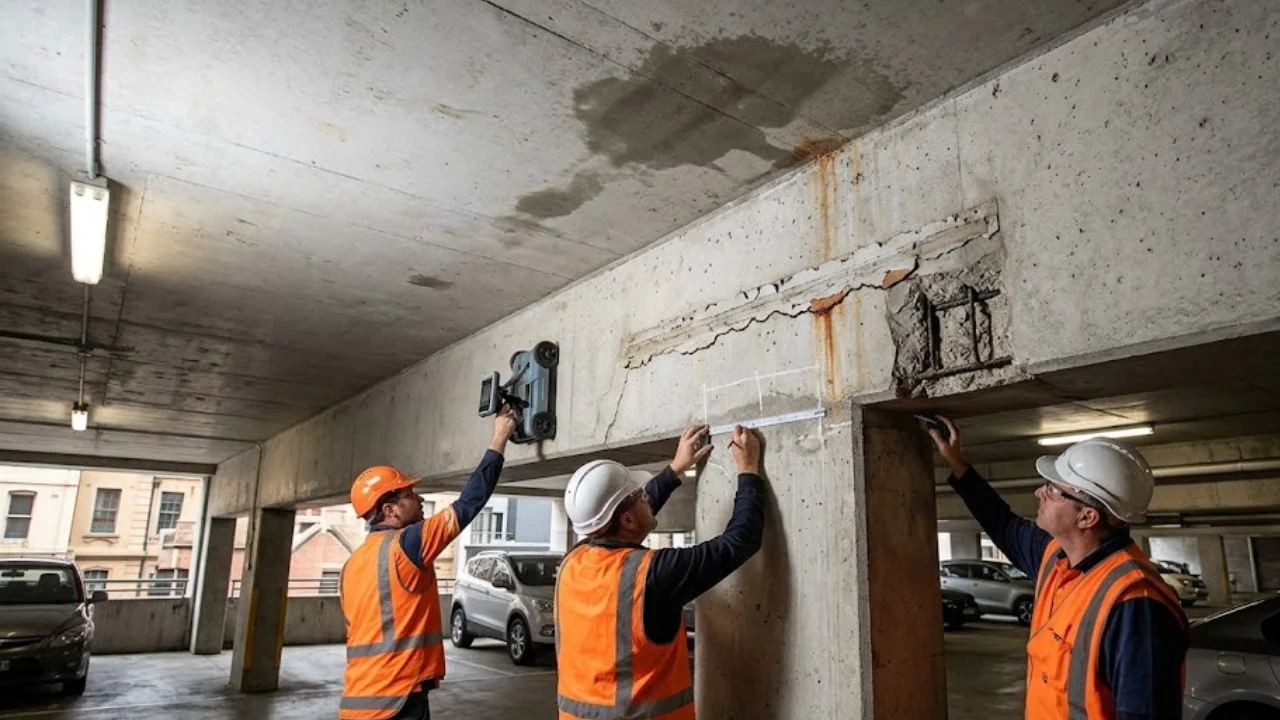
A concrete crack is repaired. The surface is cleaned, the damaged area is filled, the finish looks neat and the building goes back into normal operation.
Then, months later, the same crack appears again.
For property owners, facility managers, strata committees and contractors, this can be one of the most frustrating concrete problems to deal with. The immediate reaction is often to repair the visible damage again. But a recurring crack is usually telling you something important: the movement, moisture, corrosion or structural condition that caused the original crack may still be present.
This is becoming increasingly relevant across Australia as owners place greater attention on maintaining existing buildings and extending the service life of concrete structures. Infrastructure Australia has reported that ageing assets and reactive maintenance are placing pressure on asset lifespans, costs and resilience, with greater emphasis now being placed on maintenance and renewal of existing infrastructure.
For Sydney property owners, the real question is not simply, “How do we fill this crack?”
It is:
“Why did the crack come back?”
A Repaired Crack That Returns is Giving You Useful Information
When a crack reappears in almost the same location, the repair itself may not be the main problem.
Concrete moves. Structures respond to temperature, loading, moisture, settlement and changes in their surrounding environment. If that movement continues after the repair, the repaired area can become stressed again.
The same thing can happen when water continues to enter through a wall, slab or construction joint. A repair may close the visible opening, but persistent moisture can continue affecting the surrounding concrete and reinforcement.
That is why recurring cracking deserves investigation rather than repeated patching.
What a recurring crack may be telling you
What you notice | Possible reason |
|---|---|
Crack returns in exactly the same location | Ongoing movement or unresolved structural issue |
Crack becomes wider | Continued movement or loading |
Crack appears after rain | Water ingress or drainage issue |
Rust staining appears nearby | Possible reinforcement corrosion |
Concrete begins breaking away | Deterioration beneath the surface |
Crack appears around a joint | Joint movement or deterioration |
Several cracks appear together | Broader structural or environmental issue |
Crack appears around a previous repair | Incompatible or inadequate repair strategy |
These signs do not provide a diagnosis on their own. They indicate that the repair needs to be considered alongside the condition of the surrounding structure.
The Most Common Mistake is Treating the Crack as the Problem
Think about a leaking roof.
Painting over the water stain might make the ceiling look better for a short time, but the leak has not disappeared. The same principle can apply to concrete.
A crack can be the visible result of another problem occurring within or around the structure. If that underlying condition remains active, the crack may return even after a technically neat repair.
For example, a crack in a basement wall may be associated with ongoing water pressure. A crack in a suspended slab may relate to structural movement or reinforcement deterioration. A crack in a ground supported floor may be associated with settlement or changes in the supporting ground.
The repair method therefore needs to match the reason the crack exists.
Five Reasons Concrete Cracks Can Return
There is no single cause behind recurring concrete cracking. In practice, several conditions can produce similar looking damage.
1. The Structure Is Still Moving
Some cracks are associated with movement that has not stopped.
Thermal changes, structural loading, settlement and other forms of movement can cause a repaired crack to reopen. If the repair material cannot accommodate the movement or the crack is repaired without addressing the source, the problem may return.
This is why an engineer may need to determine whether a crack is stable or active before recommending a repair method.
2. Water is Still Getting in
Water is one of the biggest enemies of long term concrete durability.
A crack can provide a pathway for moisture to reach deeper areas of a structure. In reinforced concrete, persistent moisture can contribute to reinforcement corrosion. As reinforcement corrodes, it can expand and place pressure on the surrounding concrete, eventually causing cracking and spalling.
A repair that closes the visible crack without addressing the water source may therefore have limited long term success.
This is particularly relevant to basements, retaining walls, car parks, balconies and other structures exposed to persistent moisture.
3. Reinforcement Corrosion is Continuing
A crack can sometimes be the beginning of a much larger deterioration process.
When reinforcement inside concrete starts corroding, the corrosion products occupy more volume than the original steel. The resulting pressure can cause cracking and eventually concrete delamination or spalling.
If the damaged concrete is repaired but the reinforcement remains in a deteriorated condition, the same area can deteriorate again.
A useful warning combination
Cracking + rust staining + dampness + concrete breaking away
When these signs occur together, the problem deserves more than a cosmetic repair.
4. The Wrong Repair Method Was Selected
Not every crack should be repaired in exactly the same way.
A stable structural crack can require a very different approach from a crack that continues to move. A dry crack may also require a different treatment from one affected by active water penetration.
This is where repair selection becomes important.
Repair approach depends on the crack condition
Crack condition | Important consideration |
|---|---|
Stable structural crack | Suitable injection or repair system may be considered |
Moving crack | Movement needs to be assessed before repair |
Water bearing crack | Water source and ingress need attention |
Corrosion related crack | Reinforcement condition should be assessed |
Surface shrinkage crack | Structural injection may not be appropriate |
Crack with concrete loss | Damaged concrete may require removal and reinstatement |
This is one reason concrete repair Sydney projects should begin with an assessment of the damage rather than immediately selecting a product.
The right material applied to the wrong problem can still produce a poor result.
5. The Structure Has Been Asked to Do More Than Before
Buildings change.
A warehouse may receive heavier equipment. A commercial property may undergo refurbishment. A car park may experience different traffic patterns. Plant rooms may receive new machinery. A building may even undergo a change of use.
Those changes can alter the loads carried by existing concrete elements.
If cracking begins after a significant change in loading, it is worth considering the structural context rather than treating the crack as an isolated surface issue.
This is particularly important for older buildings where the original drawings may not fully represent later modifications.
What About Crack Injection?
Crack injection can be an effective repair technique for suitable concrete cracks, but it is not a universal answer.
The first step is to determine what type of crack is present and what condition exists around it.
Injection may be considered where the crack characteristics, structural requirements and surrounding concrete make the technique appropriate.
For example, epoxy based systems can be used for certain stable cracks where bonding and structural restoration are required. Other materials may be more appropriate where water ingress or movement is involved.
That distinction matters.
Concrete crack injection in Sydney should not be treated as a single product based solution. The crack, concrete condition, moisture, movement and structural requirements all need to be considered.
When Epoxy Injection Makes Sense
Epoxy injection is commonly associated with repairing suitable cracks in structural concrete.
Its effectiveness depends heavily on the condition of the crack and the surrounding concrete. If the crack continues to move significantly, simply filling it with a rigid material may not address the underlying issue.
Before epoxy crack injection work begins, the crack should therefore be assessed for factors such as:
- Width and depth
- Crack location
- Structural significance
- Moisture condition
- Evidence of movement
- Surrounding concrete quality
- Reinforcement condition
- Previous repair work
The purpose is not to make the crack disappear visually. The purpose is to select a repair strategy that is appropriate for the actual condition of the structure.
The Repair History Can Reveal What Went Wrong
One of the most overlooked sources of information is the building’s own repair history.
If a crack has already been repaired twice and has returned twice, the previous work should be reviewed before another repair begins.
Was the crack active?
Was there water entering the structure?
Was reinforcement corrosion present?
Was the surrounding concrete deteriorated?
Was the repair material suitable?
Was the crack prepared correctly?
Was the repair actually designed for the condition?
A recurring problem can sometimes provide more information than a newly discovered crack because there is already a history to examine.
A Practical Investigation Can Change the Repair Decision
A good investigation does not need to mean opening up the entire structure.
The approach can begin with a visual inspection and a review of available drawings, previous repair records and site conditions. From there, additional testing can be selected based on the findings.
For larger or more complex structures, engineers may consider concrete scanning, GPR, thickness testing, material assessment or other investigation methods.
This is particularly useful when the crack occurs in an area where reinforcement, post tension elements, services or other concealed features may be present.
Concrete injection work should therefore sit within a broader repair strategy where the condition of the structure has been properly assessed.
A Recurring Crack in a Strata Building is Not Just a Cosmetic Issue
This subject is particularly relevant to Sydney strata properties.
The NSW Government states that owners corporations are responsible for maintaining and repairing common property, including concrete slabs, garages, balconies and boundary walls.
The issue is significant enough that NSW Government agencies continue to monitor serious building defects across strata communities.
The 2025 NSW strata defects research found that 53 per cent of buildings surveyed had serious defects, the same proportion recorded in the 2023 research. The proportion of buildings with serious defects reported to the regulator increased to 36 per cent, compared with 34 per cent in 2023 and 15 per cent in 2021.
These figures do not mean every concrete crack represents a serious building defect. They do show why building maintenance and timely investigation deserve proper attention.
NSW Government guidance also warns that delaying repairs can increase costs and risks.
Car Parks are a Good Example of Why Cracks Return
Concrete car parks experience a particularly tough combination of conditions.
Vehicles create repeated loading. Rainwater can enter through exposed areas. Water can carry contaminants onto concrete surfaces. Poor drainage can leave sections damp for extended periods.
Over time, these conditions can contribute to deterioration.
A crack in a suspended car park slab may therefore require a different assessment from a small crack in an internal residential floor.
The location of the crack matters. So does its relationship to beams, columns, joints, reinforcement and drainage.
PRO TIP
If a crack in a car park keeps returning, photograph it at regular intervals and record its location. Changes in width, length, surrounding staining or concrete loss can provide useful information for the engineer assessing the problem.
Why Repeated Repairs Can Become More Expensive
Repeatedly repairing the same crack can create a false sense of progress.
The surface looks better, but the underlying condition remains.
A property owner may then pay for several rounds of patching, injection or surface treatment before eventually commissioning an investigation that identifies the real cause.
A better approach is to consider the likely cause when the crack first demonstrates a pattern of recurrence.
Approach | Short term result | Long term risk |
|---|---|---|
Repeated surface patching | Better appearance | Crack may return |
Repair without moisture control | Crack may close temporarily | Water related deterioration may continue |
Injection without assessing movement | Local repair | Crack may reopen |
Repair without checking reinforcement | Damage removed visually | Corrosion may continue |
Investigation followed by repair | More informed intervention | Better chance of addressing the underlying issue |
The cheapest repair on paper is not always the lowest cost solution over the life of the building.
When a Crack Deserves Immediate Attention
Not every crack requires emergency action. Fine surface cracking can occur for relatively minor reasons.
The situation changes when cracking is accompanied by other warning signs.
Look more closely when you notice:
- Rapidly increasing crack width
- Rust staining
- Concrete breaking away
- Water entering through the crack
- Significant changes in floor or wall levels
- Cracking around structural supports
- Multiple cracks appearing in the same area
- Cracks returning soon after repair
- Visible reinforcement
- Cracking following major building modifications
The combination of symptoms is often more useful than any single sign.
THINGS TO REMEMBER
A recurring crack is information. It tells you that something may still be happening within the structure.
Repair material is only one part of the solution. Crack behaviour, moisture, reinforcement and structural movement can all influence the result.
Water should never be ignored. Persistent moisture can contribute to deterioration and reinforcement corrosion.
Old repair records matter. Previous failures can help identify what needs to change in the next repair.
Not every crack requires injection. The repair method should reflect the actual condition.
Older buildings deserve closer assessment. Existing structures may have undergone modifications that are not fully captured in current documentation.
Early investigation can prevent repeated repair costs. Finding the cause before carrying out another repair can produce a more sensible long term maintenance strategy.
Fixing the Crack Should Be the Start, Not the End
A concrete crack that returns after repair is not necessarily evidence that concrete repair does not work. More often, it means the original repair did not fully address the conditions affecting the crack.
The solution may involve crack injection. It may involve concrete repair, reinforcement treatment, waterproofing, drainage improvements or structural strengthening. In some cases, several measures may be required together.
The important part is establishing why the crack exists and what is causing it to remain active.
For Australian property owners, this approach is becoming increasingly important as ageing buildings and infrastructure require better maintenance and longer service lives. Infrastructure Australia has highlighted the need for stronger maintenance and renewal practices across existing assets rather than relying predominantly on new infrastructure investment.
Stop Repairing the Same Crack Twice
At Concrete Engineering Solutions, we help property owners, builders, contractors, strata teams and project managers investigate recurring concrete damage and identify practical repair strategies. Our work can include concrete crack assessment, concrete injection, structural concrete repair and investigation of the conditions contributing to recurring deterioration.
If a crack has already been repaired and has returned, that is the point to stop treating it as an isolated surface defect.
Find out what is making the crack return, then repair the concrete with the cause in mind.