
Concrete Engineering Solutions
When Does a Concrete Crack Require Injection Instead of Surface Sealing?
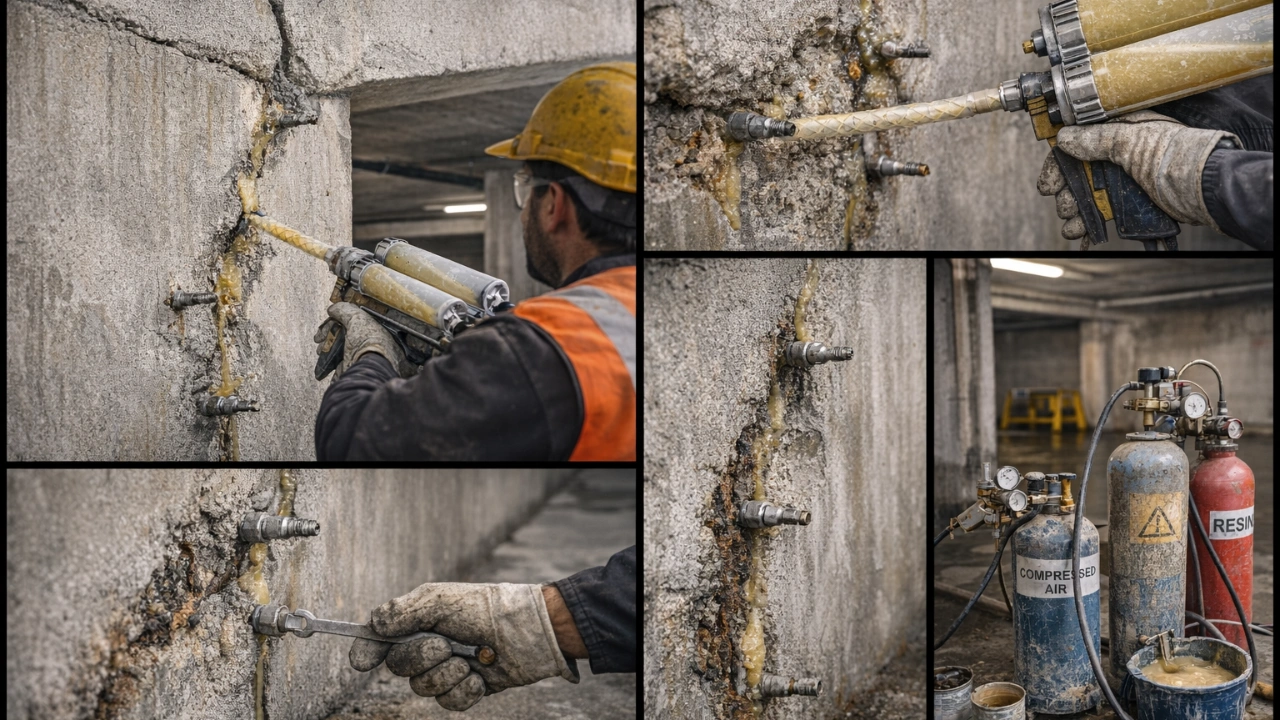
Cracks in concrete are common. The real question is not whether a crack exists; it’s what that crack is doing.
Many property owners assume that sealing a surface crack is enough. In some cases, it is. In others, it is completely inadequate and can even make the problem worse.
Knowing when an injection is required instead of simple surface sealing comes down to one thing: structural behaviour.
The Difference Between Sealing and Injection
Surface sealing treats appearance and moisture at the top layer.
Injection restores internal integrity.
Sealing is suitable when:
- The crack is shallow
- There is no movement
- The structural capacity is unaffected
- The purpose is mainly waterproofing
Injection becomes necessary when:
- The crack passes through the structural depth
- Load transfer has been compromised
- Reinforcement may be exposed or affected
- The crack allows ongoing water ingress
- The crack continues to widen
Surface sealants do not restore strength. They simply close the visible opening.
Injection, on the other hand, bonds the concrete internally and reinstates continuity.
Signs That Injection is Structurally Required
Not every crack needs aggressive intervention. But there are clear warning signs.
1.The Crack Is Active
If a crack changes width over time, it indicates movement. Sealing an active crack traps stress inside the element.
2.The Crack Runs Deep
If the crack extends through the slab or wall thickness, structural continuity is interrupted. Internal bonding is required.
3.There Is Water Penetration
Water passing through structural cracks accelerates corrosion. Moisture combined with oxygen attacks reinforcement.
4.Reinforcement Is Visible or Rust-Stained
Corrosion expansion is a structural issue. Surface repair will not stop internal steel deterioration.
In these cases, professional concrete crack injection is not optional; it is necessary to restore structural performance.
Why Surface Sealing Often Fails
We regularly see sealed cracks that reopen within months.
Why?
Because the underlying stress or movement was never addressed.
Surface materials sit on top. They do not penetrate through the crack. If the structural section has separated under load, only internal bonding can restore behaviour.
Sealing may temporarily improve appearance, but it does not reconnect the structural section.
How Injection Works in Structural Terms
Injection is not about filling gaps. It is about restoring monolithic behaviour.
When properly designed, the injected material:
- Bonds to both sides of the crack
- Transfers load across the section
- Prevents moisture ingress
- Stabilises further crack propagation
The selected material depends on the crack type and behaviour.
Epoxy is typically used when structural strength must be restored.
Polyurethane is often used where water control is the primary concern.
The method must match the cause.
Why Diagnosis Comes Before Injection
One of the biggest mistakes in remediation is injecting cracks without understanding why they formed.
Before injection, assessment should consider:
- Is the movement ongoing?
- Has the load pattern changed?
- Is a settlement involved?
- Is corrosion the primary driver?
- Are environmental conditions accelerating deterioration?
Without proper evaluation, injection can lock in stress or simply redirect cracking elsewhere.
Professional concrete crack repair in Sydney should always begin with cause identification, not product selection.
When Injection is the Smarter Choice
Injection is generally preferred when:
- The structure must regain its load capacity
- The crack is structural, not cosmetic
- Demolition would be excessive
- The building is occupied and disruption must be minimised
- Long-term durability is required
In Sydney’s coastal and high-moisture environments, restoring structural continuity early prevents much larger remediation later.
PRO Tip: Monitor Crack Behaviour Before Acting
If unsure whether a crack is active, measure its width and monitor it over several weeks.
If it changes, do not seal it blindly.
Movement tells you the structure is still adjusting. In those cases, sealing alone will not solve the problem.
Common Mistakes Property Owners Make
- Assuming all cracks are cosmetic
- Applying hardware store sealants to structural cracks
- Ignoring rust staining
- Delaying repair until spalling occurs
- Choosing the cheapest short-term solution
Concrete deterioration follows a predictable pattern. Early structural intervention prevents escalation.
Frequently Asked Questions
Can I just seal a structural crack?
No. Surface sealing does not restore load transfer or structural integrity.
Is the injection permanent?
When properly diagnosed and executed, injection can restore long-term performance. Durability depends on proper material selection and preparation.
Is epoxy always better than polyurethane?
No. Epoxy is generally used for structural bonding. Polyurethane is typically used where water ingress control is required. The choice depends on crack behaviour.
Are all basement cracks structural?
Not always. However, cracks allowing water ingress should be assessed properly before treatment.
How quickly should structural cracks be repaired?
As soon as movement or corrosion is identified. Delay increases repair scope.
Summary
Not every crack needs injection. But every crack needs understanding.
Surface sealing works for minor, stable defects. Injection is required when structural continuity has been compromised.
The decision should never be based solely on appearance. It should be based on behaviour, load performance and long-term durability.
When treated correctly and early, structural crack repair is controlled and precise. When ignored, it becomes complex and expensive.