
Concrete Engineering Solutions
When Concrete Floors Start Cracking: Could Hidden Voids Beneath the Slab Be the Real Problem?
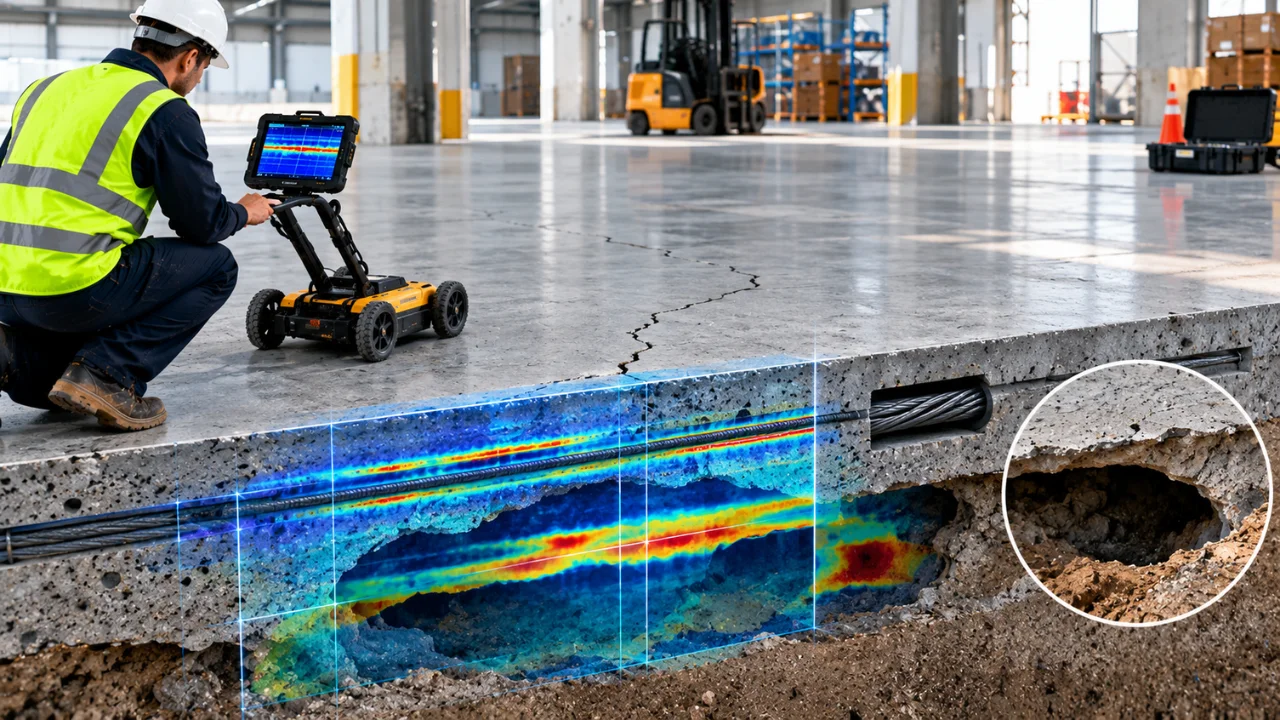
A crack running across a concrete floor is easy to notice. The harder question is why it appeared in the first place.
Sometimes the cause is relatively simple, such as shrinkage, thermal movement or surface deterioration. In other cases, the visible crack is only the symptom of a much deeper problem. A loss of ground support, an underground void or poorly compacted material beneath the slab can change how loads are transferred and eventually cause cracking, settlement or uneven movement.
This matters across Australian commercial, industrial and infrastructure sites where concrete floors may carry vehicles, machinery, storage systems, plant equipment and heavy operational loads. Infrastructure Australia has highlighted the growing pressure on ageing assets and the importance of better maintenance and renewal of existing infrastructure.
For property owners and project teams, the lesson is straightforward: do not assume that repairing the visible crack will fix the real problem.
A Concrete Crack Can Tell You More Than You Think
Concrete floors rarely crack without a reason. The pattern, width, location and progression of a crack can provide useful clues about what is happening within the slab and below it.
A crack close to a joint may have a different cause from a crack running diagonally across a large warehouse floor. Cracking around columns, loading zones or machinery areas can also point towards changes in stress or support conditions.
The surrounding environment matters as well. Water movement, soil conditions, drainage problems, previous excavation work and changes in loading can all affect the behaviour of a concrete floor.
This is why an engineer should look at the whole floor system, rather than treating the crack as an isolated surface defect.
What Could Be Sitting Beneath the Slab?
Concrete slabs are supported by the material beneath them. Depending on the project, this may include compacted fill, natural ground, engineered subgrade, gravel layers or other construction materials.
If that support becomes compromised, the slab can behave differently.
A void can develop beneath a slab for several reasons. Water may wash fine material away. Poor compaction may leave weak zones. Old service trenches may settle over time. Leaking pipes can also erode supporting material, while changes in groundwater conditions can affect the ground beneath the floor.
In older facilities, previous construction work can add another layer of complexity. Extensions, removed machinery, abandoned services and earlier repairs may have changed the conditions below the slab.
Common causes of voids beneath concrete floors
Possible cause | What can happen |
|---|---|
Water erosion | Supporting soil or fill may be removed |
Poor compaction | Local settlement can occur over time |
Leaking underground pipes | Soil can become saturated or displaced |
Old service trenches | Backfill can settle differently from surrounding ground |
Ground movement | Sections of the slab may lose uniform support |
Construction defects | Weak areas may remain beneath the slab |
Previous excavation | Replacement material may settle after construction |
Drainage failure | Persistent moisture can affect supporting materials |
A void does not always mean the entire slab is unsafe. Its size, location, depth, surrounding ground conditions and effect on structural behaviour all matter.
Why Filling the Crack May Not Solve the Problem
Imagine a warehouse floor with a long crack running across a section that regularly carries forklifts.
A repair crew fills the crack, smooths the surface and the floor looks good again. Several months later, the same crack returns.
That can happen because the repair addressed the visible opening, rather than the movement that caused it.
If part of the slab is moving because it no longer has consistent support underneath, a surface repair may only provide a temporary result. The repaired section continues to experience movement, and the crack can reopen.
This is one of the most important principles in concrete remediation:
Repair the cause, not just the evidence of the cause.
The Floor Tells a Story Through Its Crack Pattern
Engineers often look closely at crack geometry because different patterns can indicate different mechanisms.
For example, a crack that remains relatively stable may require a different response from a crack that continues to widen or extend. A network of cracks may indicate a different issue from one dominant crack associated with local settlement.
The location of the cracking can also provide valuable information.
Pay particular attention when cracking appears:
- Around heavy machinery or plant
- Along old excavation lines
- Near drains and pits
- Around loading areas
- Near structural columns
- Beside expansion or construction joints
- In areas affected by water ingress
- Along sections that appear lower than the surrounding floor
None of these signs automatically proves that a void exists. They indicate that further investigation may be worthwhile.
Water is One of the Biggest Clues
Water and concrete floors have a complicated relationship.
Concrete itself can tolerate water, but persistent water movement beneath a slab can create serious problems for the supporting ground. If water travels through fine soil or poorly compacted fill, it can carry particles away and gradually create unsupported areas.
A small leak may therefore become a much bigger structural concern over time.
Drainage problems can produce similar issues. If water repeatedly accumulates beside or beneath a slab, the ground may lose its original characteristics. In some situations, settlement follows.
PRO TIP
If a floor has cracking and unexplained water problems, investigate both issues together. Repairing the crack while leaving the source of water movement unresolved can result in recurring damage and unnecessary repair costs.
How Engineers Investigate Suspected Voids
Finding a void is not simply a matter of looking at the surface.
The investigation normally begins with a site inspection. Engineers can review the crack pattern, floor levels, drainage arrangements, nearby structures and the history of the site.
The next step depends on what the initial assessment reveals.
Non destructive investigation methods can help identify areas that require closer attention. Ground Penetrating Radar can provide information about features within and beneath suitable concrete structures, while other testing methods can assist with assessing the condition and construction of the slab.
In some projects, targeted openings or other forms of verification may also be required.
The objective is not to carry out every possible test. It is to gather enough reliable information to establish what is causing the floor to behave differently.
Where Concrete Scanning Fits Into the Investigation
Concrete scanning in Sydney can be particularly useful when an investigation involves an existing slab with unknown construction details.
Before drilling, coring or creating inspection openings, it is important to know what is embedded within the concrete. Reinforcement, conduits, tendons and other concealed elements may be present.
Scanning can therefore help reduce the risk of damaging hidden components during further investigation.
This becomes even more important in older commercial and industrial properties where original documentation may be incomplete or subsequent modifications may not appear on historical drawings.
GPR Can Help Build a Picture Below the Surface
Ground Penetrating Radar is valuable because it can provide information without immediately cutting into the concrete.
GPR Scanning projects may involve the investigation of concrete slabs, walls and other structural elements where hidden construction details need to be identified.
For a floor suspected of having support problems, GPR findings can form part of a wider investigation. The information may help identify areas that warrant further examination, particularly when combined with visible cracking, floor level changes and site history.
It is important to keep expectations realistic. GPR is an investigation tool, not a magic detector for every underground condition. Soil type, moisture, slab construction and other site factors can affect the quality of information obtained.
A qualified professional needs to interpret the results alongside other evidence.
Concrete Thickness Can Change the Engineering Picture
A slab may appear substantial from the surface, but its actual thickness can vary from one location to another.
This matters because slab thickness affects structural capacity, stiffness and the behaviour of the floor under load.
Concrete thickness testing can provide useful information when engineers need to verify existing construction before repair, strengthening or modification work.
For example, an industrial facility may have increased its equipment loads since the floor was originally constructed. If cracking is now appearing in heavily loaded areas, engineers may need to assess both the condition of the slab and the capacity of the supporting ground.
Looking at only one side of the problem can produce an incomplete answer.
What Happens When a Void is Confirmed?
The repair method depends heavily on the size, location and cause of the void.
Small localised voids may require a different treatment from extensive areas beneath a heavily loaded floor. The cause also needs attention. A leaking pipe, drainage problem or unstable fill should not simply be ignored.
One possible remediation method is concrete grouting.
Suitable grout materials can be introduced into selected voids to restore support or stabilise affected areas. The material, pressure, injection locations and sequence need to be determined for the particular site.
Grouting is not a universal solution. It forms part of an engineered remediation strategy where site conditions make it appropriate.
Concrete Grouting Can Restore Support Without Rebuilding the Entire Floor
Replacing an entire industrial floor can be disruptive.
Machinery may need to be relocated. Operations may have to stop. Access can become difficult and the project can create significant costs beyond the concrete work itself.
Where engineering assessment confirms that the existing slab remains suitable for service after remediation, concrete grouting solutions may provide a more targeted approach.
The objective is to restore support to affected areas and reduce unwanted movement, rather than simply covering the visible cracks.
A typical decision process may look like this
Stage | Key question |
|---|---|
Site inspection | Where is the damage occurring? |
Crack assessment | What pattern and movement are present? |
Structural investigation | What is beneath and within the slab? |
Ground assessment | Is support consistent? |
Cause identification | Why has the support changed? |
Remediation design | What intervention is appropriate? |
Repair | Can support and slab performance be restored? |
Monitoring | Has movement reduced after the work? |
This process helps prevent a common mistake: committing to a repair method before the actual problem has been established.
Heavy Loads Can Make Small Problems Much Worse
A residential garage floor and a distribution centre floor may both be made from concrete, but their operational demands can be very different.
Industrial floors may experience repeated forklift traffic, concentrated rack loads, pallet storage, heavy machinery, impact loading and constant movement.
If a small unsupported area develops beneath such a slab, repeated loading can gradually increase the damage.
The same principle applies to infrastructure facilities, workshops, manufacturing plants and other sites where concrete floors carry substantial operational loads.
A useful warning sign
If cracking appears in a location where heavy loads repeatedly pass or remain, do not automatically assume that the surface concrete is the only issue.
The supporting conditions beneath the slab deserve attention.
A Statistical Picture of Australia’s Infrastructure Challenge
Infrastructure Australia has repeatedly highlighted the growing importance of maintaining existing assets rather than concentrating only on new construction.
Its 2025 Infrastructure Market Capacity Report places Australia’s major public infrastructure pipeline at $242 billion across the five years from 2024 to 2029. The report also identifies transport as the largest category, representing $129 billion or 53 per cent of the pipeline.
At the same time, Infrastructure Australia has warned that ageing assets, reactive maintenance and limited asset information can affect service delivery, asset lifespan, cost and resilience.
That makes condition assessment increasingly important. Extending the useful life of an existing concrete asset can sometimes be far more practical than replacing an entire structure.
What Property Owners Should Watch For
Cracking deserves closer attention when it appears alongside other signs of movement or deterioration.
A single fine surface crack may not indicate a major structural problem. However, cracks that continue to develop, appear alongside uneven floor levels or coincide with water problems deserve professional assessment.
THINGS TO REMEMBER
- A concrete crack is a symptom, not always the underlying cause.
- Voids beneath slabs can reduce uniform ground support.
- Water movement can contribute to loss of supporting material.
- Old service trenches can become areas of settlement.
- Heavy repeated loading can make localised support problems more significant.
- GPR and concrete scanning can assist with investigation before intrusive work.
- Concrete thickness information can help confirm existing construction.
- Grouting may restore support in suitable conditions.
- The source of water or ground movement should be addressed as part of remediation.
- Surface crack repair alone may not solve an underlying support problem.
Do Not Let a Small Crack Become an Expensive Floor Problem
A cracked concrete floor can be frustrating, particularly when the floor is part of an active warehouse, manufacturing facility, commercial property or infrastructure site. But the crack itself may be only the most visible part of the problem.
The more important question is what is happening beneath it.
A careful investigation can establish the condition of the slab, identify hidden construction details and assess the support beneath affected areas. From there, engineers can determine if the right response involves local repair, grouting, strengthening, drainage work or a combination of measures.
That approach can save considerable time and expense compared with repeatedly repairing cracks that continue to return.
Find the Problem Beneath the Crack
At Concrete Engineering Solutions, we help property owners, builders, contractors, engineers and project teams investigate concrete floors and existing structures before repair decisions are made. Our services include concrete scanning, GPR investigation, concrete thickness assessment and concrete grouting for suitable applications.
If cracks are appearing repeatedly, the floor is showing signs of settlement or water is affecting the surrounding area, do not simply fill the crack and move on.
The crack is visible. The real problem may be underneath. Find it first, then decide how the floor should be repaired.