
Concrete Engineering Solutions
The Importance of Grouting in Infrastructure and Civil Engineering Projects
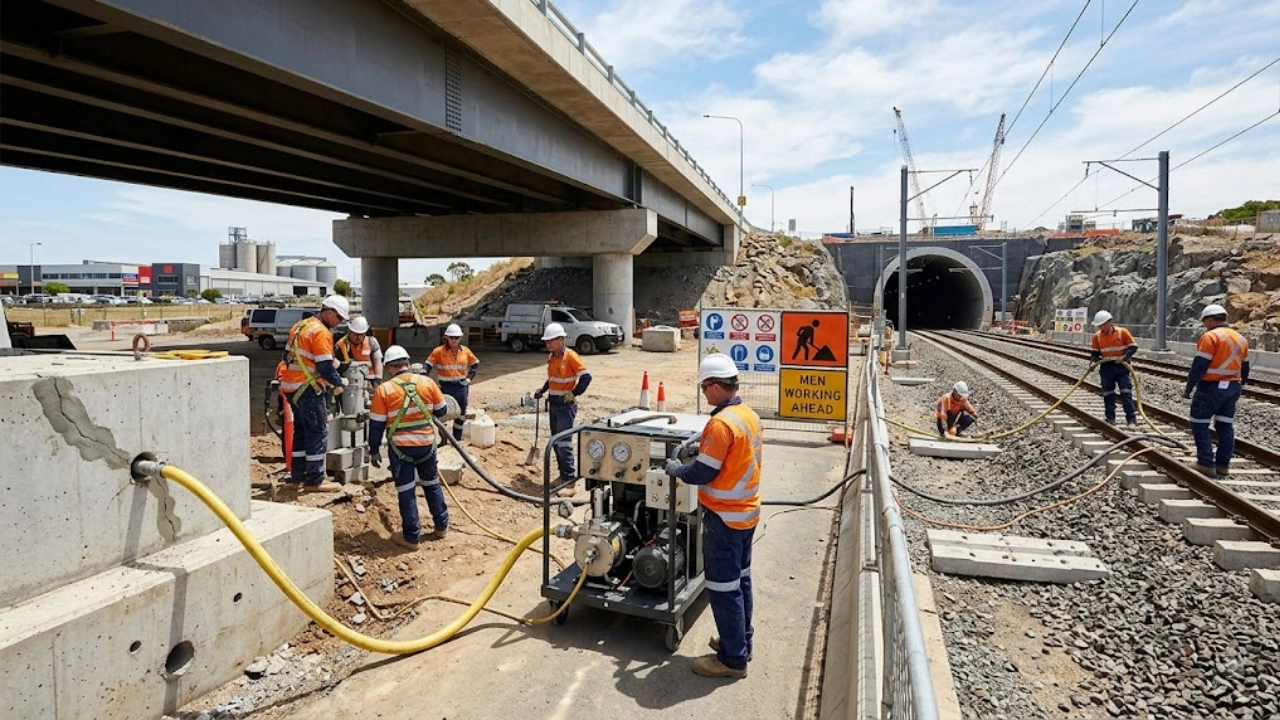
Infrastructure is the backbone of every growing city. Roads, bridges, tunnels, rail corridors, ports, industrial facilities, water treatment plants, and commercial developments all depend on strong and stable foundations to perform safely over many decades. While these structures often appear solid from the outside, their long term performance is heavily influenced by what lies beneath the surface.
One of the most important but often overlooked engineering processes is grouting. It plays a vital role in strengthening foundations, stabilising soil, filling voids, controlling water movement, and restoring structural performance. Without effective grouting, even well designed infrastructure can experience settlement, cracking, and premature deterioration.
As Australia’s infrastructure continues to expand and existing assets require ongoing maintenance, grouting has become an essential part of modern civil engineering practice.
Why Infrastructure Requires Long Term Ground Stability
Every structure transfers its load into the ground. If the supporting ground becomes unstable or develops hidden voids, the performance of the entire structure may be affected.
Natural ground conditions are rarely uniform. Changes in moisture, groundwater movement, soil composition, and previous construction activities can all influence the stability of the supporting foundation.
Civil engineers continually assess these conditions because even minor ground movement can create larger structural problems over time.
Maintaining stable support beneath concrete structures is one of the primary objectives of any successful infrastructure project.
What is Grouting?
Grouting is an engineered process where specialised materials are injected into soil, rock, or concrete to improve strength, reduce movement, or control water penetration.
Rather than replacing existing structures, grouting strengthens and improves the material already in place.
Depending on the project requirements, grout can be applied to:
- Fill underground voids
- Improve soil stability
- Seal water pathways
- Support existing foundations
- Restore damaged concrete
- Strengthen structural elements
Every project requires careful engineering assessment to determine the most appropriate grouting method.
Why Grouting Plays a Critical Role in Civil Engineering
Modern infrastructure projects often face challenging site conditions.
Construction may occur over variable soils, reclaimed land, ageing infrastructure, or locations affected by groundwater movement.
Grouting allows engineers to improve these conditions without major excavation or demolition.
This makes it a practical solution for projects where maintaining existing infrastructure is both economically and environmentally beneficial.
Common Infrastructure Applications
Grouting is used across many sectors of Australia’s construction industry.
Some of the most common applications include:
Infrastructure Asset | Purpose of Grouting |
|---|---|
Bridges | Foundation stabilisation |
Tunnels | Water control and void filling |
Rail infrastructure | Ground improvement |
Ports and marine structures | Soil stabilisation |
Industrial facilities | Foundation support |
Retaining walls | Structural reinforcement |
Each application addresses a different engineering challenge, but the objective remains the same by improving long term structural performance.
Managing Ground Movement Before It Becomes a Structural Problem
Ground movement is rarely dramatic at the beginning.
Small changes beneath a structure can gradually lead to:
- Concrete cracking
- Uneven settlement
- Misaligned structural elements
- Reduced bearing capacity
- Increased maintenance requirements
Early intervention often prevents these issues from developing into large scale remediation projects.
Grouting provides engineers with an effective method for stabilising affected areas before more serious structural damage occurs.
Supporting Existing Infrastructure Instead of Rebuilding
Australia’s infrastructure network continues to age.
Many bridges, transport facilities, industrial buildings, and commercial developments remain structurally valuable despite localised deterioration beneath foundations.
Rather than replacing these assets entirely, engineers increasingly focus on extending their service life through targeted rehabilitation.
Grouting plays a significant role in this approach by improving ground conditions while allowing existing structures to remain operational.
This strategy often delivers substantial savings compared with demolition and reconstruction.
Water Movement is a Major Engineering Challenge
One of the biggest threats to infrastructure is uncontrolled water movement.
Groundwater can gradually wash away fine soil particles, create underground voids, weaken foundations, and increase settlement risks.
Water may also enter concrete structures through joints and cracks, leading to long term deterioration.
Properly designed grouting systems help reduce these risks by sealing pathways that allow water to migrate beneath or through critical structural elements.
PRO TIP
Visible cracking is not always caused by problems within the concrete itself. In many cases, movement beneath the structure is the underlying cause. Addressing foundation conditions early can prevent repeated repair work in the future.
Supporting Sustainable Infrastructure
Modern engineering places increasing emphasis on sustainability.
Replacing major infrastructure requires significant quantities of concrete, steel, transport, labour, and energy.
Rehabilitation techniques such as grouting allow engineers to preserve existing assets while reducing construction waste and minimising environmental impact.
Extending the operational life of infrastructure also delivers long term economic benefits for both public and private asset owners.
Why Professional Investigation Comes First
No two sites behave in exactly the same way.
Before recommending any concrete grouting solution in Sydney, engineers investigate several important factors.
These may include:
- Soil conditions
- Groundwater behaviour
- Structural movement
- Existing damage
- Load distribution
- Foundation performance
Reliable investigation data allows engineers to design solutions based on actual site conditions rather than assumptions.
This improves both project performance and long term durability.
The Australian Construction Industry is Moving Towards Preventative Maintenance
Across Australia, asset owners are placing greater emphasis on preventative maintenance rather than waiting for major structural failures.
Industry research has shown that proactive maintenance programs significantly reduce lifecycle costs while improving the reliability of infrastructure assets.
Grouting supports this strategy because it allows developing issues to be addressed before they require extensive structural repairs.
For infrastructure managers, this approach provides better value over the life of the asset.
Why Experience Matters in Grouting Projects
Grouting is far more than simply filling empty spaces.
Successful outcomes depend on accurate engineering assessments, material selection, pressure control, injection sequencing, and continuous monitoring throughout the process.
Incorrect application can create additional stresses or fail to resolve the underlying issue.
This is why every grouting project should be planned and supervised by experienced professionals with a clear understanding of structural behaviour and ground engineering.
THINGS TO REMEMBER
Strong infrastructure begins with stable foundations.
Ground movement often develops slowly before visible damage appears.
Water infiltration can accelerate structural deterioration.
Grouting supports rehabilitation without major demolition.
Professional investigations provide the foundation for effective engineering solutions.
Preventative maintenance is generally more economical than large scale structural repairs.
Investing in Stronger Infrastructure for Future Generations
Australia’s infrastructure is expected to support growing communities for decades to come. Achieving this goal requires more than quality construction during the initial build. It also requires intelligent maintenance strategies that preserve structural performance as conditions change over time.
Grouting has become one of the most valuable techniques available to civil engineers because it strengthens existing assets, improves ground conditions, and reduces the need for costly reconstruction. When combined with accurate investigations and sound engineering principles, it plays an important role in protecting the long term value of critical infrastructure.
Strong Infrastructure Starts Beneath the Surface
The strength of any structure depends on the stability beneath it. If hidden voids, ground movement, or water related issues are left untreated, even the most impressive infrastructure can face unnecessary risks.
At Concrete Engineering Solutions, we believe successful engineering begins with accurate investigation and practical solutions tailored to each project. Our team works with developers, contractors, government agencies, industrial operators, and commercial property owners to deliver reliable remediation strategies that improve long term structural performance.
If your project involves ageing infrastructure, foundation movement, or structural rehabilitation, speak with Concrete Engineering Solutions today. The right engineering decision made early can protect your asset, reduce future costs, and deliver lasting confidence for years to come.