
Concrete Engineering Solutions
How to Identify When Concrete Repair Works are Structurally Required?
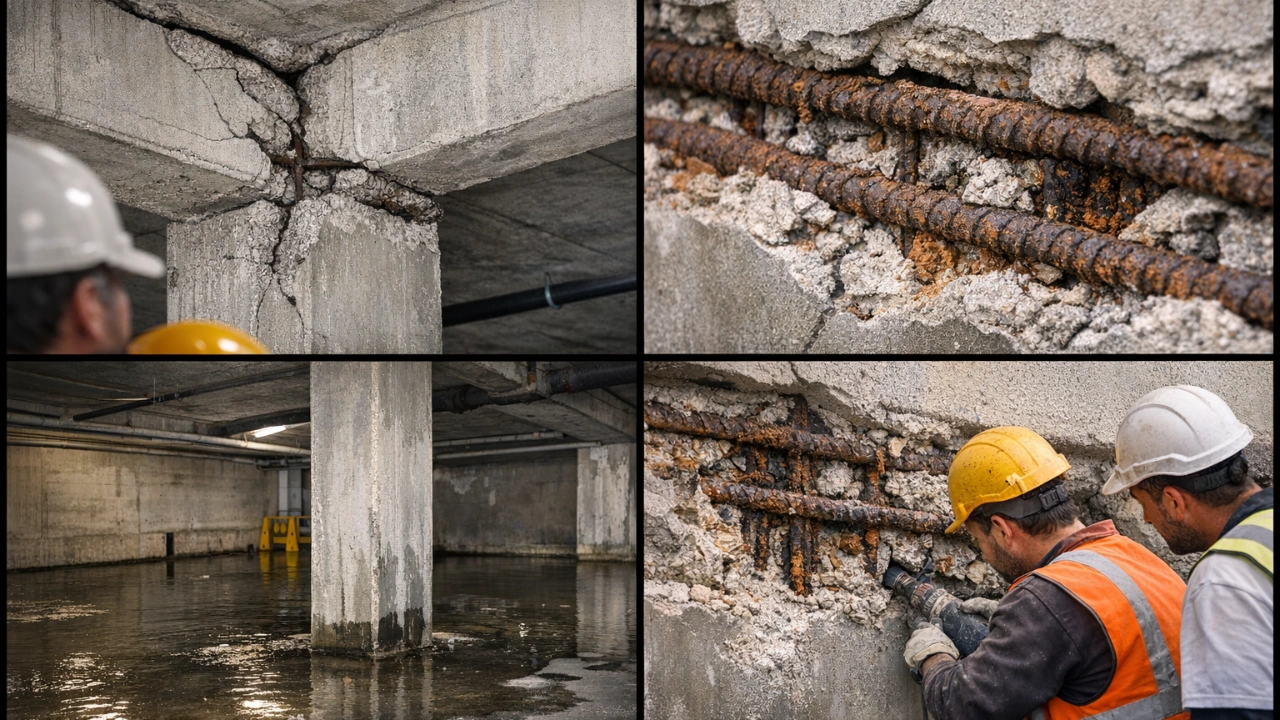
Concrete cracking is normal. Structural failure is not.
Across Sydney, we regularly inspect slabs, balconies, basements and car parks where cracks have been ignored for years. Most began as minor defects. Some remained harmless. Others developed into structural problems that required significant remediation.
The difference between cosmetic cracking and structural distress is not always obvious at first glance. That is why understanding when repair becomes structurally necessary is critical.
Cosmetic Cracks vs Structural Cracks
Not all cracks are equal. Some occur during curing and stabilise quickly. Others develop because the structure is under stress.
A cosmetic crack usually:
- Fine and shallow
- Does not widen over time
- Appears randomly without a pattern
- Shows no associated movement
A structural crack often:
- Follows a load path (near beams or supports)
- Extends through the depth of the element
- Continues to widen
- Is accompanied by deflection or settlement
- Exposes reinforcement
The behaviour of the crack matters more than its appearance.
A Practical Comparison
Below is a simplified way to distinguish between common crack types:
Feature | Likely Cosmetic | Potentially Structural |
|---|---|---|
Width | Hairline and stable | Increasing or wide |
Location | Random surface areas | Near supports or load zones |
Reinforcement Exposure | None | Steel visible or rust staining |
Movement | No change over time | Progressive widening |
Associated Defects | None | Spalling, delamination, water ingress |
This table is not a replacement for assessment. It is a guide to when further investigation is necessary.
When Structural Repair Becomes Necessary
Structural repair is required when the defect compromises the building’s ability to safely carry loads.
This typically occurs when:
- Reinforcement corrosion has begun
- Cracks interrupt structural continuity
- Settlement has altered the load distribution
- Water ingress is accelerating the deterioration
- Spalling has reduced the concrete cover
In these cases, delaying intervention increases the extent of damage.
Over time, corrosion reduces the steel cross-section. Loss of steel means reduced capacity. Reduced capacity means increased stress elsewhere in the structure.
That cycle does not reverse on its own.
This is when professional concrete repair works are essential to restore integrity and prevent progressive failure.
The Importance of Proper Diagnosis
One of the most common mistakes in remediation is treating symptoms instead of causes.
Surface patching may improve appearance. It does not restore structural continuity.
Before repair, the following must be understood:
- What caused the crack?
- Is the movement still active?
- Has loading changed since construction?
- Is reinforcement compromised?
- Are environmental factors accelerating deterioration?
Without answers to these questions, repairs often fail prematurely.
In many cases across strata and commercial buildings, poorly diagnosed repairs result in repeat cracking within 12 to 24 months.
Proper assessment ensures repairs are designed, not improvised.
Why Replacement is Not Always Required
Demolition is disruptive. It also carries risk.
In many cases, the structural core remains sound while the cover zone has deteriorated. Concrete repair works in Sydney can reinstate performance without unnecessary removal.
When correctly designed, structural repair can:
- Restore load transfer
- Reinstate protective concrete cover
- Arrest corrosion
- Extend service life significantly
This approach is especially important in occupied buildings where shutdowns affect tenants and operations.
Sydney-Specific Risk Factors
Concrete in Sydney is exposed to conditions that quietly accelerate deterioration.
Near the coast, salt in the air settles into concrete over time. That salt eventually reaches the steel reinforcement. Once corrosion begins, it expands and cracks the surrounding concrete.
Basements are another common problem area. Many buildings sit below ground level and are subject to constant moisture pressure. If the waterproofing weakens, water slowly seeps in. Over time, that moisture attacks the steel.
Heavy rainfall also plays a role. Sudden storms can expose weak points in balconies, podium slabs and retaining walls.
Then there’s the age factor. Many buildings across Sydney were built decades ago. Design standards were different. Concrete cover was sometimes thinner. Moisture protection was not always as robust as it is today.
All of this suggests that a crack may not be just a surface issue. It could be an early sign of long-term corrosion or durability stress.
That local context matters when deciding whether a crack is cosmetic or something more serious.
PRO Tip: Monitor Before You Assume
If you are unsure whether the crack is structural, mark both ends of the crack and measure its width. Re-check after several weeks.
If the crack grows or changes direction, do not ignore it.
Movement tells a story and that story should be investigated properly.
What Happens If Structural Repair Is Delayed?
Concrete deterioration follows a predictable pattern:
- Crack formation
- Moisture ingress
- Steel corrosion
- Expansion and spalling
- Section loss
- Reduced capacity
Each stage increases repair complexity.
Early intervention is controlled and precise. Late intervention is invasive and expensive.
Structural integrity should not be deferred.
Why Experience Matters
Structural repair is not about applying products. It is about understanding behaviour.
An experienced engineering-led approach considers:
- Load paths
- Material compatibility
- Environmental exposure
- Compliance requirements
- Long-term durability
This level of evaluation ensures that repairs restore performance rather than simply improve appearance.
At concrete repair works, structural assessment guides every repair methodology. That approach protects both safety and investment.
When Do You Need Professional Advice
You should seek assessment when:
- Cracks appear near columns or beams
- Rust staining is visible
- Concrete is breaking away from steel
- Water enters structural elements
- Cracking reappears after the previous repair
Early advice prevents major intervention later.
Frequently Asked Questions
Are hairline cracks always safe?
Not always. Many are harmless, but their location and behaviour must be considered.
How serious is exposed reinforcement?
Very serious. Once steel is exposed, corrosion accelerates and structural capacity may be reduced.
Can structural cracks be repaired permanently?
Yes, when properly diagnosed and repaired using engineered methods.
Is it better to repair or replace concrete?
Repair is often more efficient when the structural core is intact. Replacement is required only when capacity has been significantly compromised.
How often should buildings be inspected?
Commercial and strata buildings should undergo regular structural condition assessments, particularly in coastal or high-moisture environments.
Conclusion
Concrete cracks should never be dismissed without understanding their cause. Some are minor. Others are early warning signs of structural stress.
Identifying when repair becomes structurally necessary requires experience, technical understanding and proper evaluation.
When addressed early and correctly, structural repair restores performance and extends asset life without unnecessary demolition.
If you are unsure whether cracking in your building is cosmetic or structural, seek professional assessment before the problem progresses.