
Concrete Engineering Solutions
How Australian Infrastructure Projects are Extending the Life of Ageing Concrete Structures?
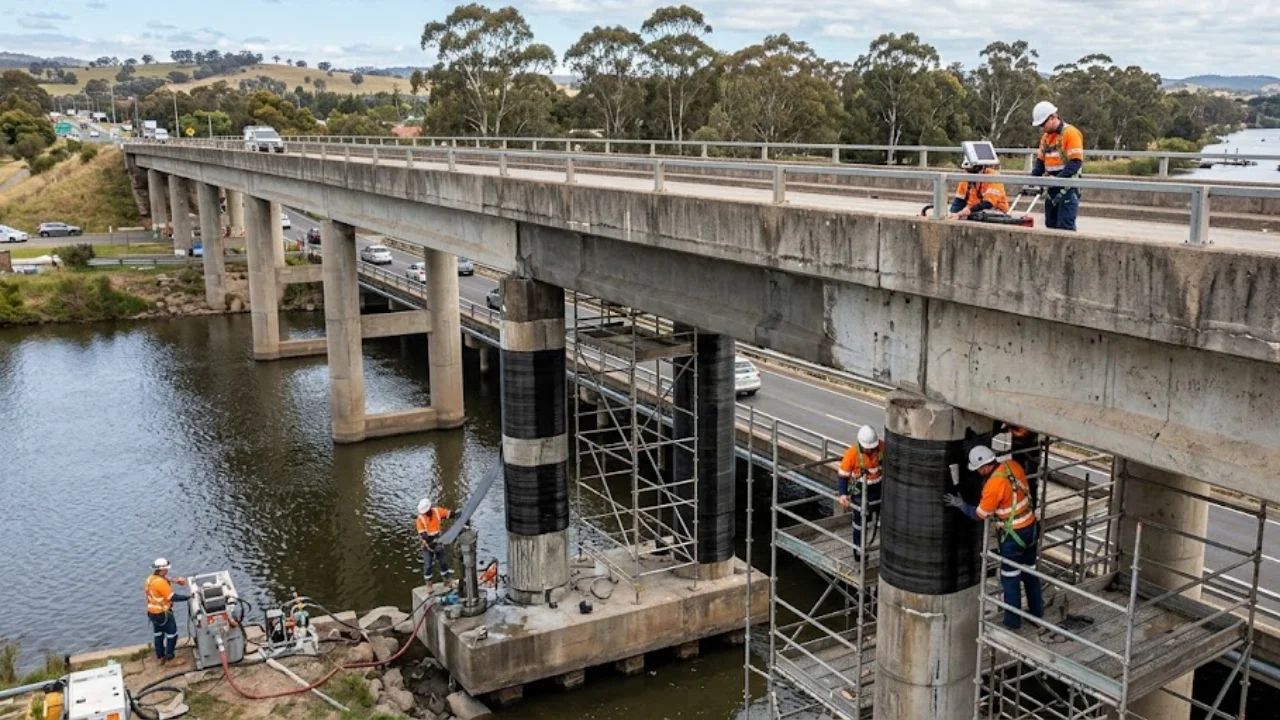
Australia has a huge amount of concrete infrastructure that has served communities for decades. Bridges, tunnels, retaining structures, transport facilities, car parks, industrial sites, marine structures and major public assets are often exposed to heavy loads, moisture, salt, temperature changes and constant vibration. As these structures age, replacing them entirely is not always the most practical or economical answer.
The focus is shifting towards repair, rehabilitation and structural strengthening. Instead of demolishing an ageing structure and starting again, engineers can assess its current condition, identify the causes of deterioration and develop a repair strategy that helps the existing concrete continue performing safely.
This approach is particularly important across Australia, where infrastructure investment continues to grow while many existing assets are reaching an age at which maintenance and rehabilitation become increasingly important.
Australia’s Ageing Infrastructure Needs a Different Approach
Concrete is remarkably durable, but it is not immune to deterioration. A structure that looked sound when it was constructed can develop cracking, reinforcement corrosion, spalling, water ingress and loss of structural capacity after decades of exposure.
The important point is that age alone does not mean a concrete structure has reached the end of its useful life. Its remaining service life depends on factors such as the original design, construction quality, loading history, environmental exposure, previous repairs and the condition of reinforcement.
For infrastructure owners, this creates an important opportunity. A well planned rehabilitation programme can often preserve a valuable structure while avoiding unnecessary demolition and reconstruction.
Common causes of deterioration in Australian concrete infrastructure
Cause | Typical impact on concrete |
|---|---|
Chloride exposure | Reinforcement corrosion and concrete spalling |
Carbonation | Loss of reinforcement protection |
Water penetration | Cracking, corrosion and internal deterioration |
Repeated heavy loading | Fatigue, cracking and local structural distress |
Poor drainage | Persistent moisture and accelerated deterioration |
Chemical exposure | Surface damage and material degradation |
Temperature changes | Expansion, contraction and cracking |
Ground movement | Cracking and changes in structural behaviour |
The right response depends on the actual condition of the structure. Repairing symptoms without identifying the underlying cause can result in the same problem returning several years later.
Rehabilitation is Often More Practical Than Replacement
Major infrastructure replacement can involve enormous costs, lengthy construction programmes, traffic restrictions, environmental impacts and disruption to businesses and communities.
Rehabilitation offers another pathway.
Engineers can assess the existing structure, determine which components remain suitable for service and identify areas that require repair or additional capacity. In many projects, only selected sections need significant intervention.
This can make a major difference to project costs and construction time. A bridge, car park or industrial structure may not need to be replaced simply because sections of concrete have deteriorated.
PRO TIP:
Do not treat visible concrete damage as proof that an entire structure has failed. A detailed condition assessment can distinguish between local deterioration and a wider structural problem, which can prevent unnecessary demolition and reconstruction.
The First Step is Finding Out What is Happening Inside the Structure
One of the biggest challenges with ageing concrete is that important defects are not always visible from the surface.
A concrete beam may have reinforcement corrosion developing beneath an apparently sound surface. A slab may contain hidden cracking or inadequate thickness. A structure may also contain reinforcement, tendons, services or previous repair materials that are not accurately represented in old drawings.
This is where investigation becomes extremely valuable.
Modern assessment methods can provide engineers with information about the internal condition of concrete before major repair work begins. Concrete scanning in Sydney can assist with locating concealed reinforcement, post tension elements and other embedded features before drilling, cutting or structural modification takes place.
For large infrastructure projects, this information can influence the entire rehabilitation strategy.
GPR Can Reveal Hidden Features Before Major Structural Work
Ground Penetrating Radar, commonly referred to as GPR, has become an important investigation technique for existing concrete structures.
Instead of relying solely on old drawings or visual inspection, GPR can help identify subsurface features within concrete. This is especially useful when engineers need to determine reinforcement locations, investigate slab construction or plan penetrations.
Large infrastructure assets often have complicated histories. Drawings may have been modified, construction records may be incomplete and previous repair work may have changed the original arrangement.
A modern investigation can therefore provide valuable information before structural intervention begins.
GPR can assist with identifying:
- Reinforcement location and spacing
- Post tension tendons
- Embedded conduits and services
- Changes in slab construction
- Areas requiring further investigation
- Potentially suitable locations for drilling or cutting
GPR does not replace engineering judgement. It forms part of a broader investigation process in which the information is assessed alongside drawings, visual observations, material testing and structural calculations.
Concrete Thickness Matters More Than Many Projects Realise
Ageing infrastructure can contain concrete elements that differ from their original documented dimensions.
Changes may have occurred during construction, refurbishment or previous repair work. In other cases, drawings simply may not provide enough information for today’s engineering requirements.
This is particularly relevant when an existing structure is being upgraded to support heavier equipment, additional loads or a change in use.
Concrete thickness testing can provide useful information about the actual dimensions of concrete elements. When combined with reinforcement detection and structural assessment, thickness information can help engineers develop a more accurate picture of the existing structure.
For example, a rehabilitation project may need to determine whether an existing slab has sufficient depth for a proposed load or whether additional strengthening is required.
Strengthening Can Give Existing Structures a New Lease on Life
Once deterioration and structural capacity have been assessed, engineers can determine the most appropriate rehabilitation method.
In some cases, repairs to damaged concrete and reinforcement may be sufficient. In others, the structure may need additional capacity because loads have increased since the original construction.
This is where carbon fibre strengthening projects can provide an efficient solution for selected concrete elements.
Carbon fibre reinforced polymer systems are lightweight and can provide additional tensile capacity without adding substantial dead load to the existing structure. They can be installed on beams, slabs, columns and other suitable structural elements following an engineering assessment.
Carbon fibre strengthening may be considered when:
Project situation | Potential benefit |
|---|---|
Increased loading | Additional structural capacity |
Ageing structural members | Improved performance after assessment |
Change of building use | Support for revised load requirements |
Local structural deficiencies | Targeted strengthening |
Restricted access | Lightweight strengthening system |
Heritage or sensitive structures | Less intrusive intervention in suitable cases |
The key is that strengthening should be based on engineering assessment rather than simply applying a product to damaged concrete.
Grouting Plays a Different but Equally Important Role
Not every infrastructure problem originates within the concrete itself.
Voids beneath slabs, foundations and structural elements can affect how loads are transferred into the ground. Water movement can also contribute to erosion, settlement and loss of support.
In these situations, concrete grouting services in Sydney can form part of a wider rehabilitation strategy.
Grouting can be used for suitable applications involving void filling, stabilisation and improving support conditions. The material and injection method need to be selected according to the ground conditions, structural requirements and project objectives.
This is particularly relevant to infrastructure assets where access is difficult and complete removal and reconstruction would cause substantial disruption.
The Australian Climate Adds Another Layer of Risk
Australia’s environmental conditions can be harsh on concrete infrastructure.
Structures located near the coast can face chloride exposure from marine environments. High temperatures and temperature fluctuations can contribute to movement and cracking. In areas with poor drainage, persistent moisture can accelerate reinforcement corrosion.
Marine and transport infrastructure can face additional exposure from salt, water and repeated loading.
This means rehabilitation programmes need to consider the environment surrounding the structure, not just the visible condition of the concrete.
A useful condition assessment should consider:
- The age and original construction of the structure
- Current and proposed loading
- Environmental exposure
- Visible cracking and spalling
- Reinforcement condition
- Concrete quality and thickness
- Previous repair history
- Drainage and water management
- Structural movement
- Future maintenance requirements
A repair that solves today’s visible damage but ignores the source of deterioration may provide only a temporary improvement.
Infrastructure Rehabilitation is Becoming More Data Driven
Modern structural rehabilitation is increasingly based on evidence collected from several investigation methods.
Rather than relying on a single inspection, engineers can combine site observations with non destructive testing, concrete investigation, structural calculations and historical documentation.
This provides a stronger basis for deciding which parts of an asset need repair, which require strengthening and which can remain in service.
Investigation | Information it can provide |
|---|---|
Visual inspection | Cracking, spalling and visible deterioration |
GPR scanning | Internal reinforcement and embedded features |
Concrete thickness testing | Actual depth of structural elements |
Concrete testing | Material condition and characteristics |
Structural analysis | Existing and required capacity |
Corrosion assessment | Reinforcement deterioration risks |
Ground investigation | Foundation and support conditions |
The advantage is not simply better information. It is better decision making.
An infrastructure owner can direct investment towards areas that genuinely need intervention instead of carrying out expensive work across an entire structure without sufficient evidence.
Sustainability is Becoming a Major Reason to Rehabilitate Existing Concrete
There is also a wider environmental argument for extending the service life of existing structures.
Demolition creates waste. New construction requires fresh concrete, steel, transport, labour and energy. When an existing structure can be safely rehabilitated, a significant amount of new material may not be required.
This does not mean every old structure should be retained. Safety remains the first consideration. But when engineering assessment confirms that rehabilitation is technically appropriate, extending the useful life of an existing asset can support both economic and environmental objectives.
For governments, infrastructure owners and major contractors, this can make rehabilitation an increasingly attractive part of long term asset management.
A Smarter Rehabilitation Strategy Starts Before Damage Becomes Critical
One of the biggest lessons from ageing infrastructure is that maintenance should not begin only after serious deterioration becomes obvious.
Small cracks, water ingress, localised corrosion and changes in structural behaviour can provide early warnings. If these signs are investigated and addressed at an appropriate stage, more extensive intervention may be avoided.
A planned inspection programme can also help asset owners prioritise spending. Structures with higher environmental exposure, heavier loading or known deterioration can receive closer attention.
THINGS TO REMEMBER
- Concrete can remain serviceable for many decades when deterioration is properly managed.
- Surface appearance does not always reveal the condition of internal reinforcement.
- Old drawings should be checked against actual site conditions before major structural work.
- GPR can help locate concealed elements before drilling, cutting or modification.
- Concrete thickness information can be important when assessing existing load capacity.
- Strengthening can sometimes extend the useful life of a structure without full reconstruction.
- Grouting may address support and void related problems in suitable infrastructure applications.
- The cause of deterioration should be addressed alongside the visible damage.
- Future maintenance should be considered as part of the rehabilitation strategy.
The Real Value is in Extending Service Life, Not Just Fixing Concrete
Australia’s infrastructure will continue to age while demand on many assets increases. Roads, bridges, transport facilities, commercial structures, industrial sites and public infrastructure must often carry greater demands than originally anticipated.
That does not automatically mean these structures need to be replaced.
A carefully planned rehabilitation programme can assess the existing condition, identify deterioration, verify hidden structural details and apply targeted repair or strengthening where required. This allows valuable infrastructure to remain productive for longer while reducing unnecessary disruption.
For project owners, the biggest opportunity is often found before major construction begins. Good investigation can reveal what the structure actually needs, allowing engineering resources and construction budgets to be directed towards the areas that matter most.
Give an Ageing Structure More Time to Perform
At Concrete Engineering Solutions, we help builders, contractors, engineers, developers and infrastructure teams investigate existing concrete structures and plan practical repair and strengthening solutions. Our services can support projects involving concrete scanning, GPR investigation, concrete thickness assessment, structural strengthening and concrete grouting.
If an ageing structure is showing signs of deterioration, increased loading or changes in its intended use, the next step should not automatically be demolition. Start by finding out what the existing structure can still do, where its weaknesses are and what can be improved.
The right investigation today can turn an ageing concrete asset into a structure that continues serving its purpose for many more years.