
Concrete Engineering Solutions
Before You Core a Post Tensioned Slab: Why Structural Investigation Comes First
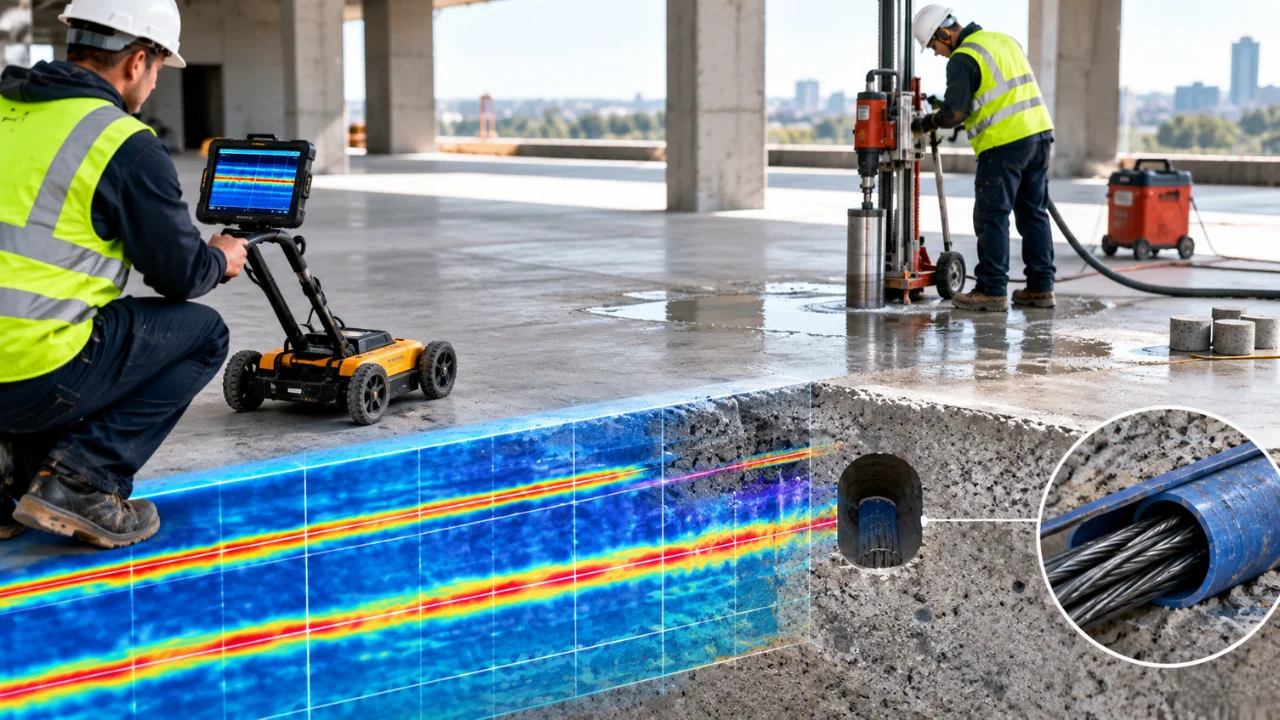
Core drilling is a routine part of many commercial construction and refurbishment projects. Contractors may need to create openings for plumbing, electrical services, ventilation, drainage, fire systems, anchors or new building equipment. On a conventional reinforced concrete slab, this can appear relatively straightforward.
A post tensioned slab is a different story.
Hidden inside the concrete are high strength steel tendons that have been tensioned after the concrete has gained sufficient strength. These tendons are an important part of the structural system, and damaging one during drilling or coring can create a serious structural problem. The danger is that the tendon cannot be seen from the surface, and its position may not always match old drawings.
For this reason, investigation should happen before the drill arrives on site, not after a contractor encounters an unexpected obstruction.
What Makes a Post Tensioned Slab Different?
Post tensioning allows concrete slabs to span larger distances and carry substantial loads while reducing the amount of conventional reinforcement required in some applications.
The tendons are placed within ducts or protective systems and then tensioned to introduce compressive forces into the concrete. This improves the slab’s ability to resist bending and cracking under service loads.
The system works as an integrated structural element. A tendon is not simply another piece of steel that can be moved or cut out when it gets in the way of a proposed penetration.
Once a tendon has been damaged, the consequences can extend well beyond the immediate drilling location.
What Can Go Wrong During Core Drilling?
Imagine a contractor has been instructed to install a new drainage pipe through an existing commercial floor. The proposed location appears clear from the surface, so drilling begins.
The core barrel progresses into the slab and suddenly hits steel.
If the steel is conventional reinforcement, the situation still requires proper assessment, but the risk may be manageable. If the steel is a post tension tendon, the situation becomes much more serious.
A damaged tendon can result in:
Incident | Potential Consequence |
|---|---|
Tendon damage | Loss of structural prestress |
Accidental cutting | Serious structural implications |
Concrete damage | Local cracking or spalling |
Incorrect penetration | Additional engineering work |
Unplanned repairs | Construction delays and higher costs |
The severity depends on factors such as the tendon location, structural design, level of damage and load carried by the affected slab.
Why Old Drawings Cannot Tell the Whole Story
Construction drawings are valuable documents, but they are not always a complete record of what exists inside an older building.
Commercial properties can undergo several refurbishment programs throughout their life. Services may be relocated, openings may be added, areas may be modified and previous repairs may alter local conditions.
There can also be differences between design drawings and the structure that was actually constructed.
That is why experienced contractors and engineers do not rely solely on paperwork when a new penetration is being planned.
A physical investigation provides another layer of confidence before work begins.
What Structural Investigation Can Reveal
A proper investigation can help establish the location of concealed structural components before drilling or cutting takes place.
Depending on the project, the assessment may identify:
- Post tension tendons
- Conventional reinforcement
- Concrete thickness
- Embedded services
- Voids or unusual features
- Suitable locations for proposed penetrations
This information allows the engineering and construction teams to make better decisions about the proposed opening.
In many cases, the best outcome is not simply finding a safe location. The investigation may show that the original penetration position should be moved to protect an important structural element.
How GPR Helps Locate Hidden Tendons
Ground Penetrating Radar is particularly valuable when investigating existing concrete because it can provide information about concealed features without cutting into the slab.
GPR equipment sends electromagnetic signals into the concrete and records reflections from objects and interfaces within the material. Engineers can then interpret the collected data to identify likely reinforcement, tendons and other embedded features.
The quality of the result depends on several factors, including concrete composition, depth, reinforcement arrangement, access, surface condition and the characteristics of the embedded object.
This is why scanning should be carried out by experienced technicians who understand both the technology and the structural implications of the information being collected.
For projects requiring GPR scanning in Sydney, the objective should not simply be to produce a scan. The information needs to be interpreted correctly and communicated clearly to the people responsible for the proposed construction work.
GPR is Not a Licence to Drill Anywhere
This point is extremely important.
A scan does not automatically make a proposed penetration safe.
The results provide valuable information about what has been detected within the investigated area. An engineer may still need to assess the proposed opening against the structural design and the purpose of the slab.
For example, moving a penetration by 100 millimetres may avoid a tendon, but that does not automatically mean the new position is structurally suitable.
The proposed opening, its size, location and purpose all need to be considered.
PRO TIP
Treat the scanning report as part of the engineering decision process, not as a simple green light for drilling. The safest location from a scanning perspective still needs to make structural sense.
Why Concrete Thickness Matters Too
Tendon location is only one part of the investigation.
Concrete thickness can also influence decisions about new penetrations, anchors, fixings and structural modifications. Existing slabs may have varying thicknesses because of structural design, construction methods, falls, toppings or previous alterations.
A penetration that appears suitable on a plan may become problematic if the actual slab configuration differs from the expected arrangement.
This is where concrete thickness testing services in Sydney can provide useful information alongside scanning investigations.
Combining information about slab thickness, reinforcement and tendon locations gives engineers a much clearer picture of the existing structure.
Refurbishment Projects Need Extra Care
Post tensioned slabs are common in commercial buildings where large column free areas are valuable.
That makes them particularly relevant to:
- Office refurbishments
- Shopping centre upgrades
- Apartment renovations
- Hotel developments
- Commercial fit outs
- Car park modifications
- Building service upgrades
These projects frequently require new penetrations for mechanical, electrical, hydraulic and communications infrastructure.
The challenge is that refurbishment work must accommodate the existing structure rather than designing around a completely new slab.
A Small Penetration Can Have a Big Impact
It is easy to assume that a small core hole presents only a small structural risk.
That assumption can be dangerous.
The importance of a penetration depends on its position and its relationship with the structural system. A small opening in one location may have little effect, while the same opening in another area could interfere with critical reinforcement or a post tension tendon.
The following factors should therefore be considered before drilling:
Factor | Question to Resolve |
|---|---|
Location | What structural elements are nearby? |
Diameter | How large will the opening be? |
Depth | How far will the core penetrate? |
Tendon position | Are post tension elements present? |
Reinforcement | Could conventional steel be affected? |
Structural role | What does the slab support? |
This approach moves the project away from guesswork and towards evidence based construction planning.
What Contractors Should Do Before Coring
The safest process starts with communication.
The contractor should provide the investigation team with accurate information about the proposed penetration, including its location, approximate size and purpose. Marking the intended core locations clearly allows the investigation to focus on the areas that actually matter.
The investigation team can then assess the slab and provide information about detected features.
If a tendon or reinforcement is identified near the proposed opening, the location can be reviewed before any damage occurs.
This simple change in sequence can save considerable time.
The Cost of Getting It Wrong
The financial consequences of an accidental tendon strike can extend far beyond the cost of repairing the immediate damage.
A project may require emergency engineering advice, temporary restrictions, structural assessment, specialist repair work and additional inspections. Construction activities can also be interrupted while the situation is investigated.
For an occupied commercial building, the consequences may include disruption to tenants and business operations.
Compared with these potential costs, investigation before drilling is a relatively small part of the overall project budget.
A Safer Workflow for Post Tension Slab Penetrations
A well planned project can follow a straightforward sequence:
Proposed penetration → site investigation → scanning → structural review → penetration approval → controlled coring
This sequence gives each party a clear responsibility.
The contractor knows where the proposed work is located. The scanning team investigates the concrete. The engineer assesses the structural implications. The drilling contractor proceeds only after the appropriate checks have been completed.
The result is a much more controlled construction process.
Why This Matters for Older Commercial Buildings
Older commercial buildings can present additional uncertainty because their construction records may be incomplete and multiple modifications may have taken place over the years.
A slab that appears simple from the underside may contain a complicated arrangement of reinforcement, tendons and services.
In these circumstances, investigation becomes particularly valuable because it replaces assumptions with information collected directly from the structure.
That information can also help with future refurbishment planning, allowing building owners to maintain better records of existing structural conditions.
The Australian Construction Industry is Becoming More Investigation Focused
The increasing amount of refurbishment and adaptive reuse work across Australian cities means construction teams are dealing with existing structures more frequently.
Instead of demolishing and rebuilding, many projects involve upgrading buildings that already contain complex structural systems.
That shift makes accurate investigation increasingly important. Contractors need to know where they can safely work, engineers need reliable information for their assessments, and property owners need greater certainty around project risks.
Post tensioned slabs are a clear example of why existing structures deserve careful investigation before modification.
THINGS TO REMEMBER
A post tension tendon is a critical structural component, not an obstacle that can simply be removed.
Old drawings should be checked against actual site conditions before important structural work begins.
GPR can help locate concealed tendons and reinforcement before drilling.
Concrete thickness information can provide additional evidence about the existing slab.
The proposed penetration should still receive appropriate engineering review after scanning.
Early investigation can prevent structural damage, construction delays and unexpected remediation costs.
Before the Core Drill Starts, Find Out What is Inside the Slab
There is a simple principle behind safe refurbishment work: do not drill into something you have not investigated.
For a post tensioned slab, that principle becomes even more important. The concrete surface tells only part of the story, while the most important structural components may be hidden several centimetres below it.
A few hours spent investigating the proposed drilling locations can prevent an incident that affects the structure, the construction program and the project budget.
Give Your Contractor Better Information Before the First Core
If your project involves new penetrations through an existing post tensioned slab, this is the stage where getting the right information can make a real difference.
Concrete Engineering Solutions works with builders, engineers, contractors, developers and property teams to investigate existing concrete structures before drilling, coring and modification work begins. Our team can help identify concealed structural elements and provide practical site information that supports safer project decisions.
Planning a core drilling project? Start with the slab, not the drill. Contact Concrete Engineering Solutions and arrange the investigation before construction work begins.