
Concrete Engineering Solutions
Why Structural Engineering Investigations Prevent Costly Concrete Failures?
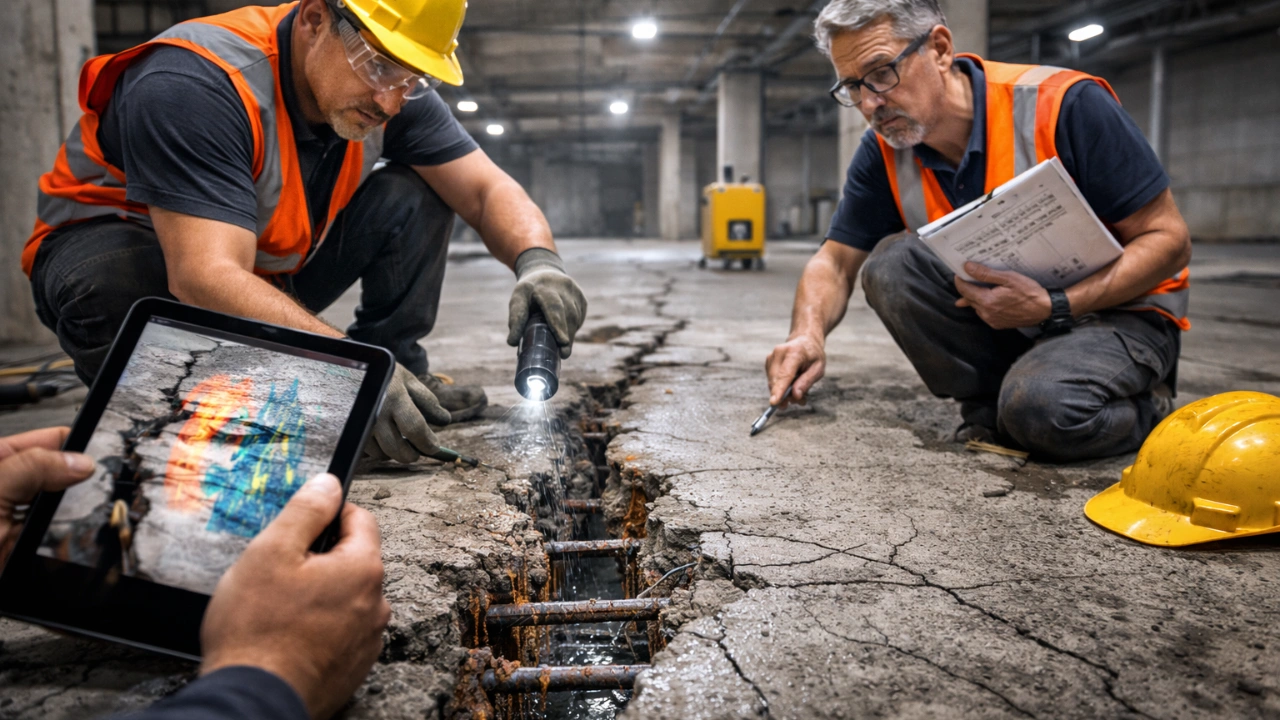
Concrete failures rarely happen without warning. Cracking, movement, water ingress or unexpected deterioration are usually symptoms of underlying issues rather than isolated defects. The problem is not that these signs appear; it’s that they are often misunderstood or addressed too late.
A structural engineering investigation is intended to answer the most important questions before remediation begins: why the issue occurred, whether it is ongoing, and what technical outcome is required to restore performance. Without this step, repairs risk being misdirected, temporary or unnecessarily expensive.
The Purpose of a Structural Engineering Investigation
The purpose of a structural engineering investigation is not to catalogue defects. It is to identify causes, assess implications and guide decisions that affect safety, durability and cost.
An investigation typically aims to:
- Determine whether observed damage is structural or superficial
- Understand load paths and how they have changed over time
- Assess whether deterioration is progressive or stabilised
- Identify contributing factors such as moisture, movement or construction detail
- Define repair objectives aligned with long-term performance
In practical terms, it provides the evidence base for selecting the right remediation strategy, rather than the quickest or most convenient one.
When Investigations are Required: Signs and Triggers
Not every surface defect requires a full investigation. However, certain signs and triggers should prompt an engineering assessment before any repair is specified.
Common Triggers
- Cracks that are wide, stepped, or increasing over time
- Recurrent cracking after previous repairs
- Differential movement between adjoining elements
- Water ingress associated with cracking or joints
- Corrosion staining or concrete spalling
- Changes in building use that increase loading
In Sydney, investigations are particularly important for older assets where original documentation may be limited, and for post-tensioned structures where drilling or repairs can carry a higher risk.
Why Skipping Investigation is a High-Risk Decision
When remediation proceeds without understanding the cause, the outcome is often predictable: the problem returns.
Skipping the investigation can lead to:
- Repairs that address symptoms but not causes
- Locking in stresses that create new cracking
- Incompatible repair materials or methods
- Escalating costs as multiple repair cycles are required
For example, sealing a crack caused by ongoing movement may temporarily improve appearance, but it does nothing to restore structural continuity. The result is often further cracking adjacent to the repair.
From a risk perspective, the most expensive failures are rarely sudden; they are the cumulative result of incorrect early decisions.
How Investigations Guide Correct Repair Methods
A key value of investigation is that it narrows the solution set. Rather than asking “what repair can we apply?”, the question becomes “what outcome is required to restore performance?”
Matching Repairs to Causes
- If cracking has compromised continuity, concrete crack injection may be required to re-establish load transfer.
- If deterioration is limited to the surface zone, resurfacing may be appropriate once underlying issues are addressed.
- If movement is ongoing, repairs may need to accommodate or control that movement rather than restrain it.
This cause-and-effect approach prevents over-repair in some cases and under-repair in others.
Avoiding Over-Repair and Unnecessary Replacement
One of the most overlooked benefits of investigation is cost control through precision. Without evidence, decisions tend to be conservative, often defaulting to removal and replacement.
However, full replacement is disruptive, costly and not always technically justified. In many Sydney assets, the structure remains sound while surface performance has declined. In such cases, targeted repair strategies can be adopted confidently.
This is where solutions like concrete resurfacing in Sydney can be specified appropriately, after confirming that the underlying element is structurally adequate and that resurfacing will deliver durable results.
The Role of Context in Sydney’s Built Environment
Sydney’s construction context adds complexity to remediation decisions:
- Coastal exposure accelerates moisture-related deterioration
- High-rise and podium structures rely on post-tensioned systems
- Mixed-age building stock includes legacy detailing
- Many sites remain operational during remediation
Investigations account for these realities. They ensure repairs are compatible with the asset’s environment, usage, and constraints, not just the visible defect.
FAQs
When should an engineering investigation be carried out?
When defects suggest structural involvement, are recurring, or may affect safety or durability.
Can repairs proceed based on visual assessment alone?
Visual assessment identifies symptoms, not causes. Investigation provides the basis for effective repair.
Does investigation slow projects down?
In most cases, it prevents delays by avoiding failed repairs and rework.
Is the investigation only for major defects?
No. Early investigation often reduces the scope and cost of remediation.
Investigations as a Risk-Management Tool
Beyond technical outcomes, investigations play a critical role in risk management. They provide:
- Defensible decision-making
- Alignment with duty-of-care obligations
- Clear justification for repair scope
- Reduced likelihood of dispute or escalation
For asset owners and project managers, this clarity is as valuable as the technical findings themselves.
Making Informed Remediation Decisions
Effective remediation is not about applying the strongest repair; it is about applying the right one. Structural engineering investigations ensure that repair methods align with:
- The nature of the defect
- The behaviour of the structure
- The intended future use of the asset
This alignment is what prevents short-term fixes from becoming long-term liabilities.
Summary
Concrete failures are rarely sudden or isolated. They develop over time, often signalling their presence well before serious consequences arise. The difference between a controlled repair and a costly failure often comes down to one decision: whether the problem was properly understood before action was taken.
Structural engineering investigations provide that understanding. They turn uncertainty into evidence and guide repairs that restore performance, manage risk and protect value.
In Sydney’s complex built environment, that clarity is not optional; it is essential.